Choosing the right 50 gallon storage tank depends on intended use, material durability, and how you plan to refill and transport the liquid. This guide highlights five practical options across residential, agricultural, and mobile settings, with attention to construction, compatibility, and maintenance. Each option offers a different balance of robustness, portability, and ease of integration with existing equipment.
| Product | Brand | Main Use | ||
|---|---|---|---|---|
| RomoTech 82123919 Horizontal Square Reservoir | RomoTech | Water/Non-flammable liquids | Polyethylene (UV-stabilized) | Agricultural, RV, emergency prep |
| Tradesman 73750 Vertical 50-Gallon Tank | Tradesman | Liquid storage | Steel (14-gauge) | Construction, agricultural use |
| Class A Customs T-5000 50 Gallon Tank | classAcustoms | Fresh/Gray water storage | NSF approved materials | RV and concession applications |
| Norwesco 50 Gallon PCO Tank | Norwesco | Water/chemicals storage | Polyethylene | Transport and space-limited setups |
| LATHEVEE Drinking Water Storage Container | LATHEVEE | Portable drinking water bag | PE + Mesh + PVC | Emergency, RV, camping, disaster prepping |
RomoTech 50 Gallon Horizontal Reservoir

The RomoTech 82123919 is a durable 50 gallon polyethylene tank designed for non-flammable liquids. Built for outdoor use, it features UV stabilization to resist sun exposure and rustproof construction for long-term outdoor deployment. The large fill cap, integrated drain, and molded bulkhead fittings simplify refilling, draining, and hose connections, making it well-suited for agricultural operations, emergency prep kits, and mobile setups where reliability matters.
Tradesman 50-Gallon Vertical Liquid Storage Tank

The Tradesman 73750 is a 50-gallon vertical tank made from 14-gauge steel with a black finish. It is designed for construction and agricultural use and aligns with Tradesman’s cross-bed box configurations. It should not be used for transferring gasoline or other flammables, nor as an auxiliary fuel tank. Its robust steel construction provides durability in harsh job-site environments while remaining compatible with fixed storage setups.
Class A Customs T-5000 50 Gallon Tank
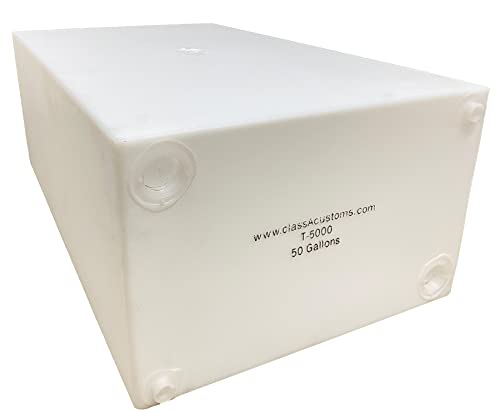
The Class A Customs T-5000 holds 50 gallons for fresh or gray water storage, with NSF-approved materials ensuring safety for drinking and service water. It measures about 38.25 inches in length and supports multiple orientations, making it versatile for irregular RV spaces or concession setups. Built-in fittings include two 1.5″ female NPT and two 0.5″ fittings; the design emphasizes watertight seals and straightforward connection, balancing tank capacity with ease of plumbing integration.
Norwesco 50 Gallon Multi-Purpose Tank

The Norwesco 50 Gallon PCO Tank offers a low-profile, durable polyethylene design ideal for storing water, chemicals, and fertilizers. UV-stabilized construction helps resist weathering, and the compact footprint makes it suitable for trailers or tight spaces. Polyethylene provides chemical resistance while maintaining light weight for maneuverability and compatible with standard cap and drainage configurations.
LATHEVEE 50 Gallon Drinking Water Storage Container

The LATHEVEE 50 gallon water bladder is a versatile portable option suitable for emergencies, RV use, camping, and disaster prep. Constructed with a three-layer fabric including PE, mesh, and PVC, it emphasizes BPA-free safety and foldable portability. The design supports quick filling and cleaning, with reinforced seams and multiple outlet adapters for flexible integration with water lines and containers. It is ideal where fixed tanks are impractical or space is limited.
Buying Guide: Key Purchase Considerations
- Material compatibility: Choose polyethylene tanks for chemical resistance and light weight, or steel for higher impact durability and wider mounting options.
- Liquid type: Confirm the tank is rated for your intended liquid (water, agricultural chemicals, fuels, gray water) and ensure any NSF or safety certifications apply to your use case.
- Mounting and space: Measure installation area and assess whether a horizontal, vertical, or folding bladder design best fits your space and transport needs.
- Connections and fittings: Check the number and size of fittings (NPT sizes, bulkhead compatibility) and whether built-in caps, drains, or bulkheads meet your plumbing plan.
- Portability vs. permanence: Portable caddies or foldable bladders suit mobile roles, while rigid tanks suit stationary setups with fixed plumbing.
- Maintenance and cleaning: Consider ease of cleaning, residue resistance, and access to drain ports or hose connections to simplify routine maintenance.
- Regulatory and warranty considerations: Review NSF approvals, warranty terms, and any safety certifications relevant to water or chemical storage.
- Cost vs. lifespan: Balance upfront cost with expected lifespan, especially in rugged environments or outdoor exposures where UV and impact resistance matter.