When restoring or reinforcing a basement, choosing the right floor jack posts and joist supports is essential for safety and precision. The following hand-picked options are designed to handle heavy loads, offer adjustable height ranges, and provide dependable temporary or secondary support during leveling projects. Below, you’ll find concise product summaries, practical usage notes, and a buyer’s guide to help you compare features side by side.
| Product | Brand | Max Load | Height Range | Notes |
|---|---|---|---|---|
| VEVOR House Floor Jack (53″-93″) | VEVOR | 18,000 lbs (8,164 kg) | 53″ – 93″ (134.6 cm – 236.2 cm) | Heavy-duty, quick-height adjustment with two lock pins |
| VEVOR House Floor Jacks 2 Pack (54″-150″) | VEVOR | 11,200 lbs (5,080 kg) each | 54″ – 150″ (137.2 cm – 381 cm) | Two-pack option for broader lifting capability |
| 2 PCS Adjustable House Jacks Post (19″-36″) | yeshine | 4,400 lbs (2,000 kg) per jack | 19.7″ – 33.5″ (50 cm – 85 cm) | Zinc-coated, temporary or secondary support |
| OPERMAXER 4 PCS Basement Floor Jack (19″-36″) | OPERMAXER | 4,400 lbs (2,000 kg) each | 19″ – 36″ (48 cm – 91 cm) | Swivel bar included; galvanized finish |
| NAXVIO House Floor Jack (48″-93″) | NAXVIO | 18,000 lbs (8,164 kg) | 48″ – 93″ (122 cm – 236 cm) | Simple operation; fast leveling capability |
VEVOR 53″–93″ Heavy-Duty Basement Floor Jack

Designed for substantial lifting tasks, this VEVOR model uses robust Q235 steel to safely support up to 18,000 pounds. The height is adjustable from 53 to 93 inches, enabling precise leveling across variable floor joist heights. Operation is straightforward: a turning lever allows height changes without extra tools, and two lock pins provide secure locking during use.
VEVOR 2-Pack Floor Jacks (54″–150″)
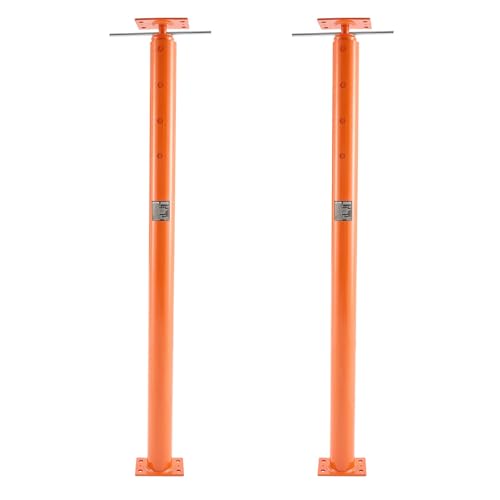
This two-pack option increases flexibility for larger spaces or bilateral lifting. With a height range of 54 to 150 inches, these posts can adapt to higher ceilings or deep joist supports, all while maintaining a solid 11,200 pounds per post capacity. The design focuses on tool-free height adjustment via a turning mechanism and comes with eight locking pins for enhanced security.
YesHine 2 Pack Adjustable House Jacks Post

These galvanized steel jacks offer a 19.7″–33.5″ height range with a 2-ton (4,400 lb) load rating per jack. They’re designed for temporary or secondary support during leveling and construction work. The zinc coating provides anti-corrosion performance, making them suitable for damp basement environments and long-term setups.
OPERMAXER 4 PCS Basement Floor Jacks

OPERMAXER’s four-pack offers consistent 4,400-pound capacity per jack with a 19″–36″ height range. The set includes a swivel bar to maximize leverage for leveling and stabilization tasks. The galvanized finish adds corrosion resistance, which is beneficial for basement environments where moisture is a factor.
NAXVIO 48″–93″ Floor Jack For Leveling

The NAXVIO model combines a high load capacity with practical height flexibility. At 18,000 pounds maximum, it’s well-suited for heavy lifting tasks common in basement renovations. The 48″ to 93″ height range supports a wide array of joist configurations, and the unit emphasizes ease of use with a simple swivel mechanism for height adjustment.
Buying Guide: Key Considerations For Basement Floor Joist Supports
Selecting the right basement floor jack post depends on your project scale, space, and required stability. Here are essential considerations from multiple perspectives:
- Load capacity: Prioritize posts with a load rating that exceeds the heaviest component you plan to lift. In this list, several models offer 4,400 pounds per jack or up to 18,000 pounds per unit, which covers typical joist or beam scenarios.
- Height range: A broad range helps accommodate uneven floors and tall basements. Look for adjustable ranges that fit your ceiling height, joist height, and desired clearance for the work you intend to perform.
- Number of posts: For large areas or heavy stringers, multiple posts provide balanced support and reduce the risk of joist sag. A 4-pack or 2-pack option can be advantageous in such cases.
- Locking pins and safety features: Secure locking mechanisms minimize accidental movement during lifting. Models that include multiple lock pins or swivel bars offer extra control during leveling tasks.
- Material and corrosion resistance: Galvanized or coated steel improves durability in damp basements. This is important for long-term installations and repeated use.
- Ease of use: Tool-free height adjustment and simple turning bars reduce setup time and labor, especially when you need to reposition multiple posts during a project.
- Temporary vs. permanent use: Some jacks are designed for temporary support during construction or repairs, not as a permanent structural solution. Align your choice with the project scope and safety requirements.
- Space and layout: In tight basements, the physical footprint and the ability to align posts with beams without interfering with utilities matter. A swivel top plate or flexible positioning can help in tight spaces.
Result-focused assessments suggest that pairing a high-capacity, long-range model with one or more auxiliary posts yields the most reliable stabilization for residential basement work. Always verify your local building codes and, when in doubt, consult a structural professional to ensure the selected supports meet safety standards for your project.