For households seeking endless hot water on demand, these systems deliver steady warmth with efficiency and flexible installation options. This guide highlights top models for different needs—large homes, outdoor use, or compact spaces—so you can pick the best fit for your family’s daily hot water use.
The buyer’s quick reference table below shows the five selected products, their primary strengths, and ideal use cases.
| Product | Best For | |
|---|---|---|
| Rheem RTGH Series 8.4 GPM (Indoor) | Large homes with multiple bathrooms indoors | 157,000 BTU, condensing, ultra-low NOx, 8.4 GPM, 0.93 UEF |
| VEVOR 10L Commercial Boiler | Commercial or high-demand setups (office, cafe) | 316 ss heater tube, 1500W, 50L/H, precise temp control |
| Ready Hot RH-200-F560 | Under-sink instant hot water with manual control | 2.5 quart tank, 140–200°F, 60 cups/hour |
| CAMPLUX AY132G Portable | Outdoor, camping, RV, off-grid | 1.32 GPM, propane, battery powered, compact |
| Rheem RTG Series Outdoor (Non-Condensing) | Outdoor setups for large families | 8.4 GPM, 180,000 BTU, non-condensing, outdoor install |
Rheem RTGH Indoor 8.4 GPM Tankless Water Heater
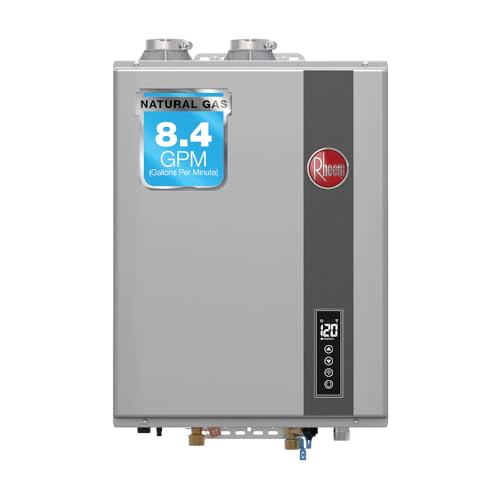
The Rheem RTGH Series indoor model is a high-efficiency natural gas tankless heater designed for whole-house use. It delivers about 8.4 GPM at a 35°F rise, powered by 157,000 BTU/h and uses condensing technology for improved energy performance. Best for larger homes with 3–4 simultaneous showers, this unit emphasizes ultra-low NOx emissions and a 0.93 UEF, helping reduce gas bills compared with standard electric tanks. Choose this for indoor installations where venting is feasible and you want efficient, on-demand hot water for multiple baths.
Best for: large families, multi-bathroom homes, and indoor installations seeking high efficiency and low emissions.
Limitation: Condensing systems can require proper venting and maintenance to sustain the high efficiency; check local code compatibility for indoor installations.
VEVOR 10L Commercial Water Boiler

The VEVOR 10L commercial boiler is designed for high-demand settings with a 316 stainless steel heating tube and a 1500W element. It can provide up to 50 liters of hot water per hour, making it suitable for cafes, offices, or busy beverage stations. The adjustable temperature range (104–201°F / 40–99°C) and LED display offer precise control, while the automatic refill and smart memory support convenient, steady operation. Best for: small commercial use, restaurants, or high-traffic service areas that require reliable hot water on demand.
Limitation: It is best used where continuous supply matters; ensure proper ventilation and electrical capacity for installation.
Ready Hot Manual Dial Instant Hot Water Dispenser

The Ready Hot RH-200-F560-BN provides instant hot water at a sink with a dedicated hot and cold faucet. A 2.5-quart stainless steel tank delivers near-boiling water at a steady rate, with manual temperature control from 140°F to 200°F. It’s ideal for kitchen prep, beverage stations, or under-sink installations where a compact, on-demand solution is desired. Best for: quick, controlled hot water at the point of use in kitchens or small offices.
Limitation: Manual control requires user adjustment; not designed for whole-house hot water supply.
CAMPLUX AY132G Portable Tankless Water Heater

The CAMPLUX AY132G is a compact, portable propane-powered tankless heater delivering 1.32 GPM for outdoor use. It runs on two D-cell batteries, suitable for off-grid settings or RV adventures where electrical access is limited. Its off-grid capability and light weight make it a practical choice for camping showers and outdoor setups. Best for: camping, RV living, or emergency outdoor hot water needs.
Limitation: Lower flow rate means it’s not suitable for full-home use; it’s best for outdoor showers and similar scenarios.
Rheem RTG Outdoor 8.4 GPM Tankless (Non-Condensing)

The outdoor version of the Rheem RTG Series provides 8.4 GPM at a 35°F rise, delivering up to 180,000 BTU/h for 3–4 simultaneous showers. It is a non-condensing design meant for outdoor installation, which simplifies venting and can be a strong choice for large homes with outdoor-ready space. Best for: outdoor installations in large homes or settings that can accommodate outdoor units with mounting space.
Limitation: Outdoor installation requires weatherproofing and appropriate clearance; maintenance avoids corrosion and venting concerns in exposed locations.
Buying Guide: Choosing The Right Continuous Hot Water System
What size is right for my home? Start with peak hot water flow needs. For homes with 3–4 showers simultaneously, look for 8.4 GPM or higher and verify BTU/h ratings. Consider whether indoor or outdoor installation is better given venting, climate, and space constraints.
Condensing vs non-condensing: Condensing models recover more heat and reduce gas usage, but may require more complex venting and maintenance. Non-condensing units are simpler but typically have higher energy costs per gallon heated.
Fuel type and emissions: Natural gas options tend to be compact and efficient, with ultra-low NOx designs in some models. If you have strict emissions requirements, prioritize models with low NOx outputs.
Installation environment: Indoor units need venting and space planning; outdoor units reduce venting needs but require weatherproofing and climate-specific considerations. Portable units fit camping or off-grid needs but are not for whole-house use.
Efficiency metrics: Look for Uniform Energy Factor (UEF) and energy savings vs. traditional tanks. Higher UEF generally means lower operating costs over time.
Maintenance and service: Consider ease of service access, warranty terms, and local code compliance. Condensing units may demand higher maintenance routines to maintain efficiency.
FAQ
- What is the difference between condensing and non-condensing tankless water heaters? Condensing models recover heat from exhaust gases to boost efficiency, while non-condensing units expel more heat with less energy recovery. Condensing units are typically more efficient but may require more complex venting.
- Can I install a tankless water heater indoors? Yes, many models are designed for indoor installation with proper venting and clearance. Follow local codes and manufacturer instructions for venting and sizing.
- How many showers can a 8.4 GPM unit support? An 8.4 GPM unit is commonly suitable for 3–4 simultaneous showers at a reasonable temperature rise, depending on incoming water temperature and other factors.
- Do outdoor tankless heaters require weatherproofing? Yes, outdoor units need weatherproof housing and proper protection from the elements to maintain performance and longevity.
- Is an adjustable temperature range important? Yes, a wide adjustable range allows precise control for different applications (kitchen, bathrooms, laundry) and energy savings.
- Do these units provide endless hot water? Tankless systems offer on-demand hot water, meaning they can provide continuous supply as long as the demand stays within the unit’s flow and heating capacity.