Answer: For exterior concrete walls, choose products designed to resist moisture, weathering, and alkali in concrete. The top picks below are suited for outdoor masonry, brick, and stucco, as well as basement or foundation walls exposed to the elements. This guide targets homeowners and DIYers tackling exterior concrete projects who want durable, long-lasting finishes with clear performance distinctions.
Summary table of selected products:
- KILZ Basement and Masonry Waterproofing Paint (1 Gallon) — Waterproofing with nanotechnology for concrete and masonry; interior/exterior versatility.
- Rust-Oleum Painter’s Touch Latex Brush-On Paint (Satin Stone Gray) — Quick-drying, low-odor, versatile for multiple surfaces.
- Hensire Black Exterior Wall Paint for Concrete & Masonry (85oz) — Durable outdoor performance on brick/concrete; large quantity.
- Hensire Black Exterior Wall Paint for Concrete & Masonry (17oz) — Compact option with similar performance for smaller areas.
- KILZ Self-Priming Masonry, Stucco and Brick Paint (White, 1 Gallon) — Self-priming with strong water repellency on textured surfaces.
KILZ Basement and Masonry Waterproofing Paint

Best for basements or exterior masonry walls requiring a water barrier. This paint uses nanotechnology to block up to 12 PSI of water pressure, helping reduce infiltration on concrete and masonry surfaces. It is suitable for both indoor and outdoor use on basement walls, stucco, brick, and concrete blocks. Not advised for floors or walls with active water leaks. The finish resists alkali buildup for durability in high-moisture areas.
Who it’s best for: homeowners tackling moisture-prone walls or below-grade surfaces needing a protective seal. Why selected: strongest explicit water barrier among listed options and proven versatility for interior/exterior masonry.
Limitation: avoid application where active leaks are present; prep with hydraulic cement for cracks and holes before painting.
Rust-Oleum Painter’s Touch Latex Brush-On Paint
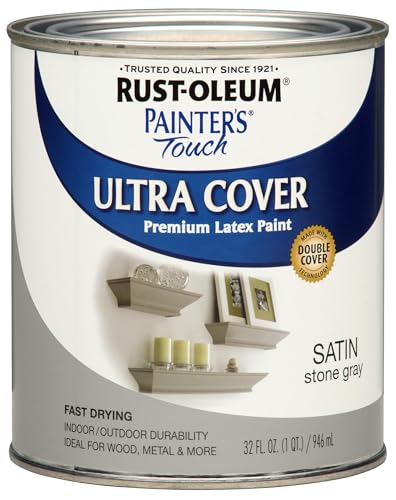
Best for mixed indoor/outdoor projects where a quick, low-odor paint layer is desired. This water-based acrylic formula adheres to wood, metal, plaster, masonry, or unglazed ceramic. It dries to touch in about 30 minutes and covers up to 120 sq ft, making it suitable for smaller exterior touch-ups or accent walls. Finish is satin, offering a balanced look for exterior masonry patches.
Who it’s best for: DIYers needing a fast, low-odor option with flexible surface compatibility. Why selected: fast-drying performance and broad surface compatibility for exterior touch-ups.
Limitation: may require more coats for full exterior protection on porous masonry compared to heavier-duty masonry paints.
Hensire Black Exterior Wall Paint for Concrete & Masonry (85oz)

Best for large exterior masonry surfaces needing a robust, dark finish. This waterproof concrete paint claims strong adhesion to concrete, resisting peeling and moisture damage even in harsh outdoor weather. Available in black, gray, or white, it provides a durable coating that suits brick facades and rough textures. Great for concealing minor imperfections with a cohesive, modern look.
Who it’s best for: exterior renovators seeking long-lasting color and heavy-duty concrete adherence. Why selected: high-adhesion, weather-resistant exterior performance with multiple color choices.
Limitation: color choice may darken or show surface texture; test color on a small area before wide application.
Hensire Black Exterior Wall Paint for Concrete & Masonry (17oz)
Best for smaller exterior projects or touch-ups where a compact can is preferred. Like the 85oz version, this paint emphasizes waterproofing and strong adhesion on concrete and brick surfaces. Choosing this option is practical for localized areas or compact jobs while preserving a consistent black finish.
Who it’s best for: homeowners addressing small exterior patches or details. Why selected: convenient size with the same foundational performance as the larger can.
Limitation: smaller volume may require more frequent can resealing or reapplication for larger walls.
KILZ Self-Priming Masonry, Stucco and Brick Paint

Best for surfaces requiring strong hiding power and good adhesion with minimal prep. This white, flat finish acrylic latex paint is water-based, offers water repellency, and is suitable for properly prepared masonry, drywall, stucco, and brick. It is alkali-resistant up to a pH of 12 and can be rolled, brushed, or sprayed for flexible application.
Who it’s best for: exterior projects where a self-priming, easy-to-apply solution is preferred. Why selected: self-priming feature reduces steps while delivering durable masonry coverage.
Limitation: flat finish may show imperfections more than satin or gloss sheens; consider surface preparation for best results.
Buying Guide: Exterior Concrete Wall Paints
- What is the primary use? Exterior concrete paints must resist moisture, cracking, and UV exposure. Prioritize waterproofing or water-repellent formulas for foundation and brick surfaces.
- What surface are you painting? Surfaces include smooth concrete, brick, stucco, or rough masonry. Some paints are self-priming, while others require a masonry primer for best adhesion.
- How important is color and appearance? Dark colors can hide imperfections but may fade differently under sun exposure. Choose UV-stable pigments and test a small area.
- What about odor and dry time? Water-based options tend to have lower odor and faster dry times, making them suitable for occupied spaces or quick projects.
- Durability vs. maintenance needs? Waterproofing and alkali resistance extend life on masonry; plan for periodic inspection and touch-ups in harsh climates.
- Size and coverage? Larger cans cover more area, reducing seams and lines. Consider whether a self-priming formula meets project scope to minimize steps.
FAQ
What is the best paint for exterior concrete walls prone to moisture?
KILZ Basement and Masonry Waterproofing Paint offers a water barrier and alkali resistance, suitable for moisture-prone walls.
Can I use indoor/outdoor paints on exterior brick?
Yes, many exterior masonry paints are formulated for brick; verify surface compatibility and weather resistance on the can.
Is a primer needed for masonry surfaces?
Some products are self-priming; others require a masonry primer for best adhesion on rough or porous surfaces.
How long does exterior masonry paint typically last?
Durability depends on climate and surface prep; check product specifications for moisture resistance and UV stability.
Are dark colors more prone to fading?
Dark colors can show fading more readily under sunlight; choose UV-stable formulations when color longevity is important.
Can I apply paint directly over old painted masonry?
Most paints will adhere to clean, sound surfaces; power wash and address cracks before applying new coats.