When inspecting fire doors, accuracy, durability, and portability matter most. This guide highlights five top tools designed to measure door gaps, flatness, and clearance with precision, helping inspectors, building managers, and safety professionals maintain code compliance. The selected products cover pocket-friendly gauges, rugged multi-tools, and purpose-built gap readers—each chosen for clear readings, robust construction, and field practicality.
Summary comparison (selected products):
- Fire Door Gap Gauge with 0.5 mm precision — compact and precise for professional inspections.
- RED Gap — compact tool with multiple built-in gap sizes for quick checks.
- Door Clearance Gauge Multicolor — ideal for onsite demonstrations and training.
- 5Pcs Firefighter Tools for Door — heavy-duty rescue tools with versatile design for emergency scenarios.
- Door Gap Measuring Tool 1-15 mm / 0.5 mm Vernier — versatile measuring wedge with vernier readout.
Fire Door Gap Gauge: 0.5mm Precision

This gauge offers 0.5 mm accuracy for detailed door gap measurements, making it suitable for professional inspections and compliance checks. Its durable metal construction and a gold-toned scale provide clear readability in the field. The compact size (15.2 cm / 5.98 inches) and wrist strap support easy transport between sites. Best for inspectors who need precise, small-gap readings without bulky tools. A limitation is that it focuses on gap measurement and may require additional tools for broader door assessment.
RED Gap: Multi-Size Gap Checker

The RED Gap provides six built-in gap sizes: 1/16″, 1/8″, 3/16″, 3/8″, 1/2″, and 3/4″, enabling quick checks across both tight tolerances and larger spacings. This makes it ideal for field surveys where speed matters and space is limited. Best for far-reaching inspections where multiple gaps must be reviewed in a single pass. Limitation: the device may not offer sub-millimeter precision beyond its fixed sizes, so use with care for official tolerances.
Door Clearance Gauge Multicolor

Designed as a training and demonstration tool, this gauge offers clearly marked indicators for quick readings and clear field feedback. It’s compact and durable, making it easy to carry during onsite evaluations. Best for on-site training sessions, facility audits, and scenarios where a visual teaching aid improves accuracy. Caution: readings may be less granular than dedicated 0.5 mm vernier tools, so pair with a precise gauge when tight tolerances are critical.
5Pcs Firefighter Tools: Rescue Set

This 5-piece tool kit emphasizes heavy-duty construction and angled design for leverage during door access and rescue tasks. While marketed for firefighting and emergency personnel, the durable steel construction and multifunctional design also support non-emergency inspections where robust pry and door tools are beneficial. Best for departments or contractors needing versatile on-site access tools. Limitation: primarily a rescue-focused kit, so users should supplement with dedicated gap gauges for strict door compliance measurements.
4 Packs Professional Firefighting Multi-Tool Kit
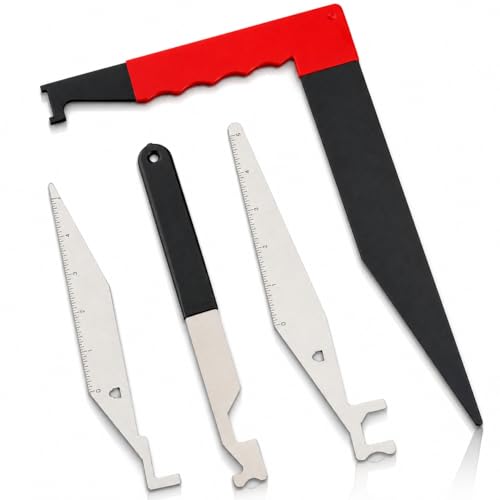
This 4-piece set features complete rescue and forcible entry tools built from high-grade stainless steel for durability in extreme conditions. It combines multiple functions, including pry and door tool capabilities, for efficient access during emergency operations. Best for first responders and facilities teams that require a comprehensive, rugged toolkit. Caution: tools are designed for rescue tasks; for routine door-gap compliance checks, dedicated measurement gauges remain essential for accuracy and documentation.
Buying Guide
Key considerations when choosing fire door inspection tools include accuracy, durability, portability, and ease of use. Below are practical questions and recommendations to help buyers select tools that fit their workflow.
How precise must my tools be?
For most compliance checks, 0.5 mm precision provides a reliable reading for door gaps and flatness. Tools with fixed gap sizes can speed up field surveys, but vernier-based gauges offer fine-grain readings that are crucial for strict codes.
Is durability more important than portability?
Inspectors often work in tight spaces and harsh environments. Metal construction with a compact form factor reduces the chance of damage and makes it easier to carry between sites. Look for wrist straps or sturdy cases for quick transport.
Do I need a multi-tool kit or single-purpose gauges?
Single-purpose gap gauges are excellent for precise measurements, whereas multi-tool kits cover broader emergency tasks. Consider combining a precise gap gauge with a compact rescue tool if you perform both compliance work and on-site access tasks.
What about training and readability?
Tools with clearly marked scales and color-coding speed readings in the field and during training. Visual indicators help reduce misreadings when multiple inspectors work on the same project.
What is the best workflow for inspections?
Start with a quick surface check using a multi-size gauge for an initial gap sweep. Then validate critical clearances with a 0.5 mm vernier gauge. Document readings with photos and a simple table for traceability.
Maintenance and storage tips
Keep gauges clean and dry to prevent corrosion. Store tools in a protective case, and periodically verify calibration against a reference standard if applicable.
Frequently Asked Questions
- What is the standard fire door gap size typically inspected? Gaps are commonly checked to ensure 1/8″ to 3/16″ tolerances, though exact requirements vary by jurisdiction and door type.
- Are vernier gauges necessary for all inspections? They are recommended when high precision is required, but fixed-size gap gauges can speed routine field checks.
- Can these tools be used indoors and outdoors? Yes, most are designed for field use in various conditions, with portable form factors for easy transport.
- Should I pair tools with documentation software? Pairing with a documentation workflow improves traceability and helps with compliance reporting.
- Do any tools require calibration? Some precision gauges may benefit from periodic calibration checks, especially in high-stakes inspections.
- Which tool is best for training new inspectors? The Door Clearance Gauge Multicolor is well-suited for demonstrations, while 0.5 mm gauges provide hands-on practice with precise readings.