Answering the demand for durable, code-compliant access doors, this guide highlights fire-rated main door options suitable for corridors, walls, ceilings, and high-traffic areas. Each product is evaluated for who benefits most, its fire rating, and practical considerations like installation and durability. This overview helps facility managers, contractors, and design professionals choose the best fire-rated door for walls or ceilings in commercial settings.
Summary Table of Selected Products
| Product | Fire Rating (Walls | Ceilings | Best For | Notes |
|---|---|---|---|---|
| Linhdor Nova 8000 Fire-Rated Access Door | 2-Hour | 1-Hour | Hospitals, schools, multi-story buildings | Dual steel, mineral wool insulation |
| Best 12″ x 12″ Insulated Panel | Up to 3-Hour | — | Small access points in fire-rated walls | Self-closing, 16-gauge frame |
| 24 x 24 Insulated Fire-Rated Door | 2-Hour | — | Mid-sized wall access in fire barriers | UL/ULC listed options |
| 12 x 12 Uninsulated Fire-Rated Door | 2-Hour | — | Dense fire barriers with simple access | UL/ULC references |
| BA-PFI Fire-Rated 24×36 Door | 3-Hour | 3-Hour | New construction or retrofits needing strong fire protection | Durable, self-closing and self-locking |
Linhdor Nova 8000 Fire-Rated Access Door
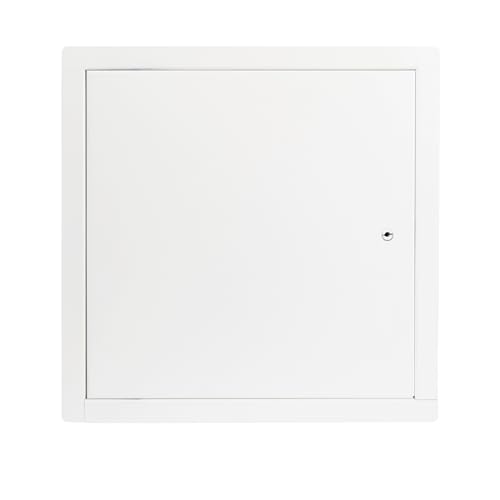
- Fire rating: 2-hour in walls, 1-hour in ceilings. Complies with commercial fire safety codes.
- Construction: Dual 20-gauge steel with 2″ mineral wool insulation; heavy-duty 16-gauge frame.
- Finish: White baked enamel primed surface, field paint-ready; UV and salt spray durability tested.
Best for: Facilities needing robust fire-rated access in high-traffic areas like hospitals, schools, and multi-story buildings. This model emphasizes structural integrity and certified fire resistance.
Why selected: It combines a high fire-resistance rating with a durable build and field-ready finish, supporting long-term performance in demanding environments.
Limitations: May require professional installation due to heavy steel framing and insulation integration.
18 x 18 Uninsulated Fire-Rated Access Door

- UL approved for 1.5 hours in walls (B label); ULC for 2 hours in walls.
- Design supports continuity in a 2-hour fire barrier wall.
Best for: Small, budget-conscious installations where fire-rated access is needed without insulation requirements.
Why selected: Provides essential fire-rated access in compact spaces, with UL/ULC labeling for compliance.
Caution: Less insulation means reduced thermal resistance compared with insulated models.
14 x 14 Uninsulated Fire-Rated Access Door
- UL labeling for 1.5 hours in walls; ULC for 2 hours in walls.
- Designed to maintain continuity in a 2-hour fire barrier wall.
Best for: Small ceiling-to-wall intersections where space is limited and insulation is not required.
Limitations: Uninsulated doors provide less thermal protection compared with insulated options.
Best 12″ x 12″ Insulated Fire Rated Metal Access Panel

- 3-hour fire rating for vertical installations; UL 10B, NFPA 252, CAN/ULC S104 listed.
- Construction: 16-gauge frame with 20-gauge galvanneal door; 2″ mineral wool insulation.
- Self-closing mechanism helps maintain fire-rated performance and code compliance.
Best for: Vertical wall access points in new construction or renovations that require up to 3 hours of fire resistance.
Why selected: Combines a solid fire rating with insulation and a self-closing feature for ongoing safety.
Best Fire Rated Insulated Access Door with Flange (24″ x 36″)
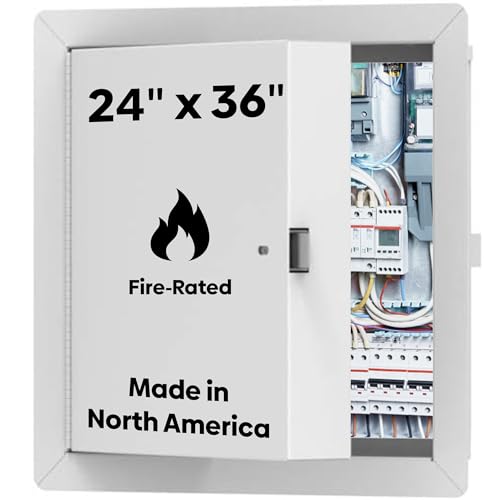
- 3-hour fire rating for vertical and horizontal installations; UL 10B, NFPA 252, CAN/ULC S104 listed.
- Durable construction: 16-gauge frame, 20-gauge galvannealed door, 2″ mineral wool insulation; self-closing and self-locking with powder coat finish.
- Flange design enables flush, versatile installation on multiple surface types.
Best for: Projects requiring high fire resistance across walls and ceilings with durable, long-lasting finishes.
Limitation: Larger size may require precise framing and professional installation to maintain fire-rated integrity.
LYNN HARDWARE Extra Heavy Duty Door Closer

- Industrial-grade closer suitable for high-traffic spaces; supports up to 5,000 openings per day.
- Three mounting options and five adjustment valves for closing speed, latching, backcheck, spring force, and delayed closing.
Best for: Commercial entrances in malls, offices, schools, and transit hubs where reliable door operation is essential.
Why selected: Complements fire-rated doors by ensuring consistent, controlled closure in busy environments.
Limitation: Not a fire-rated door itself; a closer should be paired with a compliant door assembly for full protection.
Buying Guide
- What is the required fire rating for your application? Options vary from 1 hour to 3 hours, depending on wall or ceiling location and building code.
- Is insulation important for your project? Insulated panels provide better thermal resistance and may improve energy efficiency.
- What installation considerations matter? Large or heavy doors may need professional framing, mounting, and alignment to preserve fire-rated integrity.
- Are self-closing or self-locking features needed? Self-closing helps maintain fire barriers; self-locking aids security when closed.
- Do you need vertical, horizontal, or mixed installations? Some models are optimized for vertical walls, others for horizontal surfaces or both.
- What certifications are required by local codes? UL, NFPA, and CAN/ULC listings are common benchmarks for fire-rated panels.
FAQ
- Q: Do all fire-rated access doors require insulation? A: No, some models are uninsulated; insulation affects heat transfer and energy performance.
- Q: What does a 3-hour fire rating mean? A: It indicates the door assembly maintains its integrity for up to three hours under standard fire exposure conditions.
- Q: Can I replace a standard access door with a fire-rated one? A: Replacement depends on frame compatibility and wall construction; confirm with a professional to ensure code compliance.
- Q: Are there any maintenance requirements for fire-rated doors? A: Regular inspection of hinges, seals, and the self-closing mechanism helps preserve fire resistance.
- Q: How do I choose between insulated and uninsulated doors? A: Choose insulated doors for better thermal performance and fire barrier continuity in occupied spaces.
- Q: Do fire-rated doors require labeling or certification visible on-site? A: Yes, certifications should be documented as part of the installation and inspection records.