Keeping frozen goods safe requires reliable temperature monitoring. The following wifi-enabled freezer thermometers send instant alerts, export data, and offer remote monitoring via apps. This guide highlights five strong options, detailing their features, alert types, and compatibility to help you choose the right solution for home kitchens, garages, and small businesses.
Buying considerations are summarized in the table below to help you compare at a glance.
| Brand | Model | Wi-Fi Type | Alerts | Data Export |
|---|---|---|---|---|
| MOCREO | WiFi Freezer Thermometer Alarm (2 Pack) | 2.4 GHz Wi-Fi | App push, Email, Hub alarm | 2-year data export |
| GoveeLife | WiFi Refrigerator Thermometer with Alarm (2 Pack) | 2.4 GHz Wi-Fi | App, Email, Audible Alarm | 2-year data export |
| GoveeLife | WiFi Refrigerator Thermometer with Alarm (2 Pack) | 2.4 GHz Wi-Fi | App, Email, Audible Alarm | 2-year data export |
| YoLink | Smart Wireless Thermometer Hygrometer (3-Pack) | LoRa-based (not Wi-Fi) | App, Text/Email push | Cloud export via YoLink app |
| Frigga | 4G Cellular & Wi-Fi Monitor | Cellular + Wi-Fi | App, Email, Voice Alerts | N/A (subscription included for 2 years) |
MOCREO WiFi Freezer Thermometer Alarm (2 Pack)

The MOCREO system provides 24/7 remote monitoring via a companion hub, with app-based remote mute and alerting. It supports 2.4 GHz Wi-Fi and pushes smart notifications when temperatures cross preset thresholds. In addition to app alerts, users receive email notifications and an 80 dB hub alarm. The hub includes an offline alert for power outages, plus battery and anti-false alarm features. The kit commonly ships as a 2-pack for wider coverage.
GoveeLife WiFi Refrigerator Thermometer (2 Pack)

This model emphasizes three-way alerts with continuous remote monitoring. A precision 2.7 mm NTC probe delivers ±0.9°F/±0.5°C accuracy and a fast 2-second response across -40°F to 158°F. The built-in 80 dB buzzer provides immediate audible alerts when temperatures deviate. It requires 2.4 GHz Wi‑Fi to maintain real-time monitoring and works without ongoing subscription fees for data export.
GoveeLife WiFi Refrigerator Thermometer (2 Pack) With App Control

Designed for continuous updates and reduced false alarms, this model fixes common issues with low-temperature alert spamming. It provides 24/7 app-based alerts and a gateway that can handle up to 10 sensors. A dedicated app view lets you monitor temperatures remotely from anywhere, with no subscription required for data export. The device emphasizes reliable operation through a stable 2.4 GHz Wi‑Fi connection.
MOCREO WiFi Thermometer Freezer Alarm (2 Pack)
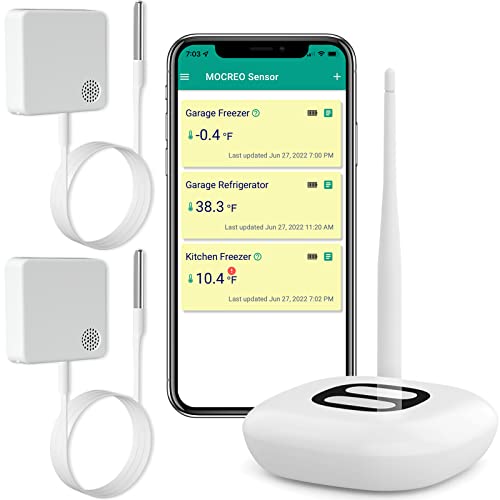
Key strengths include 24/7 remote monitoring, multiple alert channels (app, email, and an 80 dB hub alarm), and an offline alert for power outages. It supports 2.4 GHz Wi‑Fi and emphasizes reliability with anti-false alarm features. Data can be exported, and the system is suitable for residential and small commercial use, offering broad sensor compatibility within its hub ecosystem.
YoLink Smart Wireless Thermometer Hygrometer (3-Pack)

YoLink uses a LoRa-based wireless protocol rather than Wi-Fi, enabling extended range and reduced network congestion. It supports temperature and humidity monitoring with app alerts, emails, and text/sms notifications. The system is scalable, with a hub plus multiple sensors—ideal for areas where Wi-Fi is weak or unavailable. The 1/4 mile open-air range makes it suited for larger homes, greenhouses, or remote storage spaces.
Frigga 4G Cellular & Wi-Fi Temperature Monitor

Frigga combines 4G cellular with Wi‑Fi for uninterrupted monitoring, even when internet is unstable. It supports both 2.4 GHz and 5 GHz networks and includes a global SIM card with two years of cellular service. Alerts cover temperature, humidity, power failures, and disconnections via app, email, and voice. After the initial period, continued service requires renewal, but the system is designed for off-grid or vacation properties where connectivity is inconsistent.
Buying Guide
Key purchase considerations help balance coverage, reliability, and cost.
- Connectivity: Choose Wi‑Fi if you want cloud-based alerts and remote access via a single app; consider LoRa or cellular options for locations with weak or no Wi‑Fi.
- Alerts and ease of use: Look for multiple alert channels (app, email, audible hub alarms). Some users prefer automatic mute or quick acknowledgment features to minimize disruptions.
- Sensor accuracy and range: A precision around ±0.5–1.0°C or °F is common. Ensure the device supports the temperature range you need (e.g., -40°F to 158°F).
- Data export and history: If you need compliance or long-term monitoring, ensure there is straightforward data export (CSV or similar) and that the data retention period meets your needs.
- Subscription terms: Some models offer free data export but require paid subscriptions for ongoing cloud features or cellular service beyond a trial period.
- Multiple sensors: If monitoring multiple compartments, check if a gateway supports several sensors and how many can be linked.
- Durability and placement: Consider IP ratings, probe protection, and mounting options for kitchens, garages, or RVs.
All models listed provide remote temperature monitoring and alerting, but they vary in network technology, data handling, and alert mechanisms. When selecting, align the choice with your environment, whether it’s a home kitchen, a detached garage, a vacation home, or an RV scenario.