Gas leak detection is a critical safety practice for homes, RVs, and small facilities. This article reviews five reliable leak detectors that identify methane, propane, natural gas, and other combustible gases. Each device offers a mix of fast response times, gooseneck probes for hard-to-reach spots, audible and visual alerts, and user-friendly operation. Use these tools to verify lines, test installations, and monitor environments where leaking gas could pose serious risks.
Summary of selected products:
| Product | Brand | Key Benefit | Probe Type | Alerts |
|---|---|---|---|---|
| PT199 Natural Gas Leak Detector | TOPTES | Immediate 0.5s response with red LCD alert | Handheld | Audible & Visual |
| PT520A Natural Gas Detector | TOPTES | Long reach with 17-inch gooseneck | Gooseneck | Audible & Visual |
| PT205 Natural Gas Detector | TOPTES | %LEL detection for enhanced risk insight | Handheld | Audible & Visual |
| Klein Tools ET120 | KLEIN TOOLS | Wide detection range with adjustable sensitivity | Handheld | LED & Audible |
| PT-990 Rechargeable Gas Leak Detector | TOPTES | Data logging and multi-alarm system | Handheld with fan-assisted sampling | Audible, Visual, Vibration |
TopTes PT199 Natural Gas Leak Detector
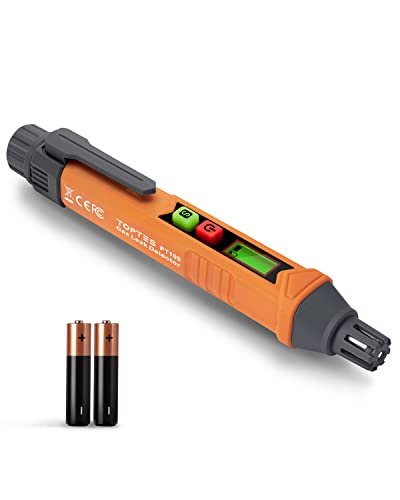
The PT199 from TOPTES detects natural gas, methane, propane, butane, LPG, and similar gases, pinpointing leaks to minimize explosion risk. It provides a rapid 0.5-second alarm onset and an LCD screen that turns red as gas concentrations rise. This compact device arrives with two AAA batteries and requires about a 30-second warm-up. A low-battery indicator appears below 2.4V, and auto-power-off occurs after five minutes of inactivity or no detection, conserving battery life.
RectorSeal Better Bubble 65554 Advanced Leak Detector

Better Bubble is an advanced leak locator suitable for refrigerant gas, air, and oxygen detection across a range of temperatures. It excels at pinpointing small leaks in natural gas, LPG, and air conditioning systems. The product is easy to apply—spray or apply on pipes, tanks, pressure vessels, condensers, and evaporator coils. Its formulation works across varied conditions, enhancing leak detection in plumbing and HVAC contexts.
TopTes PT520A Natural Gas Detector

The PT520A provides effective detection for methane, propane, natural gas, LPG, and more, with a 17-inch gooseneck for hard-to-reach areas. It targets spaces like pipelines, storage areas, gas fireplaces, and basements. A fast 0.5-second response accompanies a 75dB audible alarm and a multicolor bar display to indicate concentration levels. The detection range spans 50-10,000 ppm, supporting precise localization of leaks.
Gasoila Leak Detector Spray

Gasoila Leak Detector Spray uses fast-acting, long-lasting bubbles to locate micro leaks in gas lines, air systems, refrigerants, and gas cylinders. Its bubbles remain visible for about 10 minutes to provide clear testing results. The formula is non-toxic and non-corrosive, compatible with various pipe types, and safe for gas lines and air systems. Note that it is not suitable for oxygen systems but serves well for many common leak-testing scenarios.
EG Gas Leak Detector with 12″ Probe

EG’s portable gas leak detector covers a wide spectrum of combustible gases, including methane, propane, butane, and sewer gas. It features a 12-inch flexible probe for reaching tight spots and a loud 85 dB alarm with six LED indicators to convey gas presence and concentration. This detector is suitable for home, RV, garage, and light industrial use, offering a practical balance of reach and clarity in alerts.
Klein Tools ET120 Gas Leak Detector

The Klein Tools ET120 offers a wide detection range from 50 to 10,000 ppm, based on methane. Users can switch between High and Low sensitivity to tailor detection for different environments. It provides strong visual alerts via five red LEDs and an 85 dB audible alert that intensifies with gas concentration, supporting accurate monitoring in reports or fieldwork and ensuring prompt attention to leaks.
TopTes PT205 Gas Detector with %LEL

The PT205 model expands safety with %LEL detection, measuring methane, propane, butane, LPG, and related gases from 1%LEL to 10%LEL (roughly 100 ppm to 5,000 ppm). It maintains a 0.5-second detection speed and offers both visual and audible alarms, with a red LCD indicator for higher concentrations. The device supports comprehensive risk assessment and helps users interpret explosive limits during inspections and emergencies.
TopTes PT-990 Rechargeable Gas Leak Detector

The PT-990 is a rechargeable detector featuring a 11-inch probe and a detection range from 0 to 10,000 ppm. It includes data logging capabilities and supports multiple alert types—audible, visual, and vibration. Its built-in fan aids sample collection, offering quick, thorough screening of larger spaces and industrial environments. This model suits users who require traceability and robust alert options.
Buying Guide: Key Considerations for Gas Leak Detectors
- Detection range and targets: Choose a unit that covers the gases you are most likely to encounter (natural gas, propane, LPG, methane, etc.). Consider whether you need a broad range or a model focused on lower-leak sensitivity for fine diagnostics.
- Response time and alarms: Fast response times (0.5 seconds or better) help you identify leaks quickly. Look for combined audible, visual, and vibrating alerts for noisy environments or for use in PPE-required settings.
- Probe design: Gooseneck or flexible probes reach tight spaces. Longer probes improve access to pipes, basements, and behind appliances, reducing the need for disassembly.
- LEL awareness: Some models report %LEL or have graded bar displays. This is valuable for evaluating explosion risk levels and for training non-experts to interpret readings.
- Power and runtime: Battery-powered detectors are portable, but check warm-up times, battery life, and auto-off features. Rechargeable options like PT-990 offer data logging for audits and maintenance records.
- Usability and maintenance: Look for clearly labeled indicators, straightforward calibration, and compatibility with common gas types in your locale. Consider models with replacement parts and consumables readily available from manufacturers.
- Application scope: For home safety, compact handheld units may suffice. For industrial or RV use, longer probes, rugged housings, and data logging become valuable.
- Safety standards and certifications: Verify that detectors meet relevant safety standards and that testers have clear warranty terms and customer support.
When selecting a gas leak detector, balance sensitivity, reach, and readability against the specific environments where it will be used. A combination of a fast-responding handheld unit and a longer-probe detector can provide comprehensive coverage for residential, workshop, and light industrial settings.