Answering the need for compact, efficient cooling in tents and small spaces, these portable tent air conditioners are designed for outdoor adventures and RV setups. This guide highlights five top options, clearly stating who they’re best for and why they were selected. We focus on cooling power, energy use, portability, and noise levels to help you choose with confidence.
Summary Table of Selected Products
| Product | Best For | Key Benefit |
|---|---|---|
| Outohome Portable Camping Air Conditioner | Solo campers and small tents | Strong 5200 BTU cooling with low power use |
| FO-KOKO 5200 BTU Portable Camping AC | Budget-conscious campers needing quiet operation | 3.6°F colder airflow with dual-loop cooling |
| FO-KOKO Dual Hose 6800 BTU | Enclosed tents or vans needing faster cooling | Dual-hose design for faster cooling and heating |
| Disaenvir Tent Air Conditioner 3300 BTU | Lightweight setup and basic cooling | Three modes with quiet sleeping option |
| Cybertake S2 Pro Portable | Versatile power options and flexible control | 5100 BTU cooling, 6100 BTU heating, multi-source power |
Notes: All products include a tent- or small-space-friendly design. This guide emphasizes practical buying considerations such as power needs, operation modes, noise, and portability to help you pick the best fit for your camping style.
Outohome Portable Camping Air Conditioner

Powerful 5200 BTU cooling powered by a GMCC compressor delivers rapid temperature drops. It can reduce ambient temperature by up to 10°C (18°F) within five minutes in cooling mode. Temperature is adjustable from 16°C to 30°C (60°F to 88°F). It runs under 400W per hour, emphasizing energy efficiency. Weighing about 31 lbs with a compact 22.4 x 11.2 x 13.8 inch footprint, it offers a single-handed carry. Modes include Cooling, Dehumidifying, Sleep, and Fan, all controllable via remote. It operates quietly at 46-50dB in sleep mode, supporting undisturbed rest.
Best for: Solo campers or small tents who need strong cooling without high energy use. Limitations: May be less effective in very large tents or extremely hot environments; consider a dual-hose model for bigger spaces.
FO-KOKO 5200 BTU Portable Camping AC

This 5200 BTU unit uses dual-loop water cooling to spray water on the condenser for faster heat dissipation, delivering about 3.6°F colder airflow than standard portable ACs. It cools about 130 sq.ft, dropping temperatures by up to 18°F in five minutes with an operating range of 60-88°F. It runs on 400W, an attractive option for tents, RVs, vans, and garages. Its compact body (12.8 x 10.6 x 22.8 inches) includes a carry handle and can often stay in the carry bag for easy outdoor transport.
Best for: Campers seeking faster cooling with a compact footprint and modest power draw. Limitations: Dual-loop system adds setup complexity; ensure proper water access for best performance.
BAYKUL Portable Camping Air Conditioner & Heater

This 6-in-1 unit combines cooling and heating with a compact portable form. It’s designed for outdoor use in tents, RVs, vans, and similar spaces, offering both air conditioning and heating capabilities to match seasonal needs. The unit is positioned as your all-season cooling/heating companion for camping, roadside stops, and other outdoor activities.
Best for: Campers who want year-round climate control in a single unit. Limitations: Heating performance may depend on ambient conditions; verify heating expectations for your climate.
FO-KOKO Dual Hose 6800 BTU Portable AC

This dual-hose design delivers faster cooling (up to 50% faster) and enhanced heat dissipation, resulting in improved energy efficiency. It offers 6800 BTU of cooling and 7500 BTU of heating with five modes (Cool, Heat, Dry, Fan, Sleep) and temperature control from 60°F to 86°F. It operates quietly at about 45dB in sleep mode and supports multiple power sources through its control system, including remote access. It’s well-suited for enclosed tents, RVs, vans, and other compact spaces.
Best for: Users who need rapid cooling/heating in enclosed spaces and value low noise. Limitations: Slightly higher power use; ensure power availability for extended use.
5200 BTU Portable Tent Air Conditioner for Camping
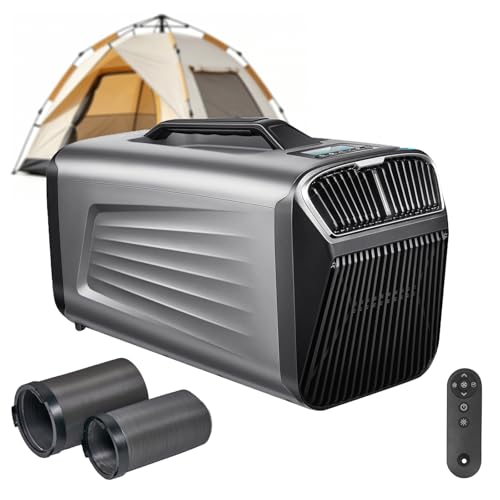
This Outohome model offers practical cooling with a 5200 BTU rating and a compact, portable form. It claims a 10°C/18°F drop within five minutes and adjustable temperature control from 16°C to 30°C. Its 400W power usage aligns with energy-conscious camping. The unit weighs around 31 lbs and uses a metal spray finish for durability. It excels for outdoor summers and indoor spaces needing efficient cooling.
Best for: Campers seeking a balance of cooling power and portability. Limitations: May not cool larger tents as quickly as higher BTU models.
Buying Guide: Portable Tent ACs
What size tent or space do you need to cool?
Measure your tent or area and compare it to the unit’s cooling capacity in BTU. Larger tents benefit from higher BTU models or dual-hose designs that improve cooling efficiency.
Is power availability a constraint?
Check the power draw (usually around 400W) and ensure you have enough electrical supply, generator, or battery capacity. Dual-hose models can use power more efficiently in some setups.
Do you need heating as well as cooling?
Some models offer heating and multi-mode operation. If year-round use matters, a 5-in-1 or 4-in-1 unit can simplify gear planning.
How important is noise level?
Campers often prefer quiet operation. Look for settings with Sleep or Low Noise modes to minimize disturbance during rest.
Portability and setup complexity
Consider weight, handle design, and whether the unit can stay in a carry bag. Dual-hose designs may require a bit more setup but can deliver faster cooling in tight spaces.
What about energy efficiency?
Energy efficiency correlates with longer usage in remote locations. Units under 400W typical draw are generally more adaptable for camping trips without frequent power runs.
FAQ
- What is BTU and why does it matter for tents? BTU measures cooling output. Higher BTU cools larger tents, but efficiency and airflow matter for best performance in small spaces.
- Can I run these on a car battery or small generator? Many units are designed for AC power, but some support DC or multi-source power. Confirm compatibility before purchase.
- Are dual-hose models better for tents? Yes, dual-hose designs often provide faster cooling and better humidity control in enclosed spaces.
- Should I choose a unit with a remote? A remote improves convenience when the AC is set up inside a tent or enclosure away from the user.
- What maintenance is needed? Regular cleaning of filters and ensuring water-based cooling components (where applicable) stay clear of debris improves performance.
- Is 60-86°F a common cooling range? Temperature ranges differ by model; select a unit whose range matches your comfort target in your camping climate.