Answering the need for reliable, high-capacity water purification, these commercial reverse osmosis (RO) systems deliver consistent, contaminant-free water for restaurants, offices, labs, and light industrial settings. The top picks below balance high output with practical features like pressure monitoring, booster pumps, and easy maintenance. This guide helps business buyers choose systems that fit water pressure, daily demand, and space constraints. The table summarizes each option for quick comparison.
| Product | Output (GPD) | Best For | Key Benefit |
|---|---|---|---|
| iSpring CRO1000 | 1000 | High-demand small business | Tankless design, on-demand filtration |
| iSpring RCS5T | 500 | Light commercial settings | Low-waste ratio, PFAS removal |
| iSpring CRO2000 | 2000 | Medium-large operations | Dual pumps, high output |
| Oceanic Commercial 800G | 800 | Medium-volume facilities | Low-waste 1:1 ratio |
| Ecoviva RO800G | 800 | High-volume, quiet operation | German seal design, 10-year life |
iSpring CRO1000 4-Stage Tankless Commercial RO System

The CRO1000 is a true commercial-grade RO system with an on-demand flow of 0.7 GPM and a high output of 1,000 GPD. It uses a tankless design to avoid traditional storage tanks, making it suitable for restaurants and small businesses that need steady filtered water without bulky tanks. Built-in inlet and outlet gauges help monitor pressure. An optional PMP1000 booster pump is recommended when supply pressure is below 80 psi.
Best for: facilities needing reliable, high-volume purified water with quick response times. Better for: spaces where a tankless setup saves footprint. Caution: booster pump may be required for low-pressure municipal water.
Selected for: its combination of high capacity and on-demand delivery, which suits cafes, small clinics, and light industrial environments that run heavy water usage during peak hours.
iSpring RCS5T Commercial Tankless RO System
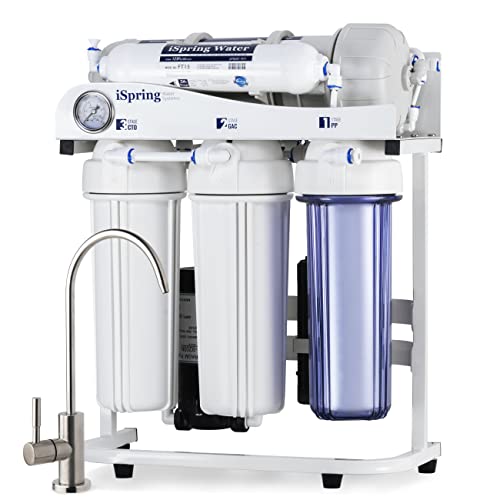
This 5-stage system is designed for light commercial use with a 500 GPD membrane. It emphasizes water quality with PFAS removal and a 1.5:1 pure-to-drain ratio, reducing wastewater. A built-in booster pump helps maintain production even under low water pressure, making it reliable for small offices, salons, labs, and cafés.
Best for: facilities needing PFAS mitigation and stable production without high energy use. Choose this if: you want low-waste operation with straightforward maintenance. Caution: output is lower than larger commercial units, which may not meet peak demand in busy environments.
iSpring CRO2000 4-Stage Tankless Commercial RO
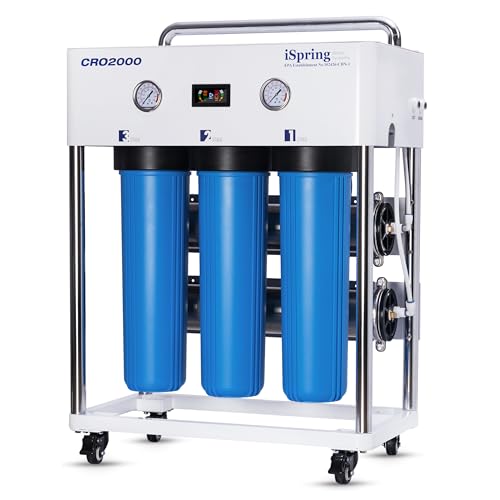
The CRO2000 delivers up to 2,000 GPD with a pair of booster pumps and dual gauges, supporting higher-volume needs. It uses an advanced RO membrane for contaminant removal, including PFAS and lead, and aims to maximize production while reducing wastewater. The dual pumps help maintain performance under variable pressure and demand.
Best for: medium-to-large operations with substantial daily water needs. Choose this if: you require high output and robust monitoring. Caution: more complex installation may require professional service and space for two pumps.
iSpring RCB3P Tankless Under-Sink RO System

This 300 GPD under-sink RO system balances compact design with strong filtration for residential and light commercial use. It removes up to 99% of contaminants and PFAS, including lead and chlorine. The stainless steel frame and mounting bracket simplify installation and future maintenance.
Best for: offices or small commercial spaces needing high-quality drinking water without a bulky RO unit. Choose this if: you require a discreet setup under a sink. Caution: lower output compared to tankless commercial systems.
Oceanic Commercial 800 GPD RO System

Premier Water Systems’ Oceanic system provides up to 800 GPD with a 1:1 waste ratio, which reduces wastewater compared to standard RO units. It targets businesses needing steady high-quality water and is capable of handling the contaminant removal typical of municipal supply protection, including lead, chlorine, fluoride, and arsenic.
Best for: mid-volume operations seeking lower wastewater. Choose this if: you need a balance of capacity and efficiency. Caution: ensure space for a compact, high-flow RO unit and associated plumbing.
Ecoviva RO800G Tankless 8-Stage System
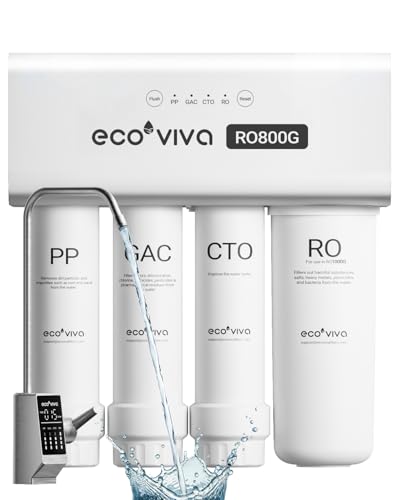
The Ecoviva RO800G is a tankless commercial-grade RO system with 800 GPD capacity and a 80-130 psi working pressure. Its 9-stage design emphasizes 99% contaminant removal, including PFAS, nitrates, and lead. The German-sealed design minimizes vibration and noise, supporting high-volume usage with long-term reliability.
Best for: high-volume facilities that value quiet operation and robust durability. Choose this if: you need long-term reliability and a compact, tankless footprint. Caution: installation may require careful noise and vibration considerations.
Buying Guide
What capacity do I need?
Estimate daily water usage in gallons and choose a unit with higher GPD than peak demand. For busy restaurants or labs, prioritize models in the 800–2000 GPD range.
Tankless vs. traditional tanks
Tankless systems save space and provide on-demand filtration, but may require consistent water pressure. Tank-based systems can offer simpler storage and steady supply for very high demand.
Water pressure and booster needs
Many commercial RO systems assume 60–100 psi incoming pressure. If pressure is low, select units with a built-in booster pump or plan for an external pump to maximize production.
Wastewater considerations
Consider the pure-to-waste ratio. Lower waste ratios (such as 1:1 or 2:1) reduce water waste, which lowers operating costs, especially in areas with high water prices.
Filtration stages and contaminants
Check the contaminants targeted by each system. PFAS, lead, arsenic, and chlorine are common concerns; multi-stage systems with pre-filtration typically remove sediment and improve RO membrane life.
Footprint, installation, and maintenance
Assess available space, ease of installation, and filter replacement accessibility. Tankless and compact designs simplify installation in tight spaces, while freestanding frames aid maintenance and relocation.
FAQ
- What is the difference between tankless and traditional RO systems for commercial use? Tankless units provide on-demand purified water and save space, while traditional tanks store water, offering a stable supply but taking more space.
- Do these systems remove PFAS? Several listed systems remove PFAS along with heavy metals and chlorine, but verify the exact stage details for each model.
- How important is the booster pump? A booster pump helps maintain production when inlet pressure is low, improving GPD and reducing strain on the membrane.
- What maintenance is required? Regular filter changes and membrane checks are standard. Monitoring gauges help track pressure and performance to prevent downtime.
- Can I install these systems myself? Some models are designed for easier installation, but professional plumbing and electrical work are recommended for commercial setups.
- Which system is best for high-volume use? Systems with 800–2000 GPD ratings and dual pumps typically perform best under high demand while maintaining efficiency.