If you want a sauna experience that’s easy to adjust from your phone or control panel, a wifi-enabled sauna heater is the right pick. These models let you set temperatures, timers, and session lengths without moving from your seat. This guide highlights top options for different spaces and budgets, including several wifi-enabled choices and solid non-wifi comparators for context. The best buyers are homeowners building or upgrading a home spa, wellness enthusiasts, and anyone who values precise, convenient control over their sauna sessions.
| Model | Brand | WiFi / Controls | Best For |
|---|---|---|---|
| HUUM Drop Series with UKU | HUUM | WiFi Control | Modern, space-saving wall-mount |
| HUUM Steel 10.5 kW | HUUM | WiFi Control | Large saunas up to 600 cu ft; robust power |
| Harvia KIP 4.5kW | Harvia | Digital Controls | Smaller to mid-sized rooms; reliable classic |
| Harvia KIP 6kW | Harvia | Digital Controls | Medium rooms; strong heat with stone cavity |
| Mxmoonant 9kW | Mxmoonant | External Digital Control | Medium to large rooms; solid performance |
Below are five focused product sections. Each entry explains who the heater is best for, why it was selected, and any practical caveats to consider before buying.
HUUM Drop Series Sauna Heater With UKU WiFi Control

The HUUM Drop Series combines distinctive water-drop design with UKU WiFi control, offering seamless smart integration for modern spas. It features wall-mounted construction and stainless steel build for durability. The exposed stones and direct-contact design promote efficient heating in a compact footprint, suitable for busy households that want app-based control. This heater is best for tech-forward buyers seeking precise online scheduling and remote adjustments. Consider that the UKU control relies on WiFi stability for consistent operation.
HUUM Steel 10.5 kW Sauna Heater With UKU WiFi

This 10.5 kW HUUM unit is designed for larger spaces and up to about 600 cu ft, supported by UKU WiFi control for smart operation. The stainless-steel construction and robust heating elements provide durability in steam-rich environments. It’s best for homes aiming for a strong, even heat with the convenience of app-based temperature and session management. If you prefer traditional wall controls without WiFi, this model would not be your best match.
Harvia KIP Sauna Heater 6kW, Wall Mounted

The Harvia KIP line is a traditional, reliable electric sauna heater with a large stone cavity for efficient heat distribution. The 6kW version is suitable for mid-sized rooms and pairs well with standard sauna stones. It uses digital controls rather than WiFi, which makes it ideal for buyers who want dependable performance without smart features. It’s best for those who value consistency and straightforward operation over remote control capabilities.
Harvia KIP80B 8kW Sauna Heater
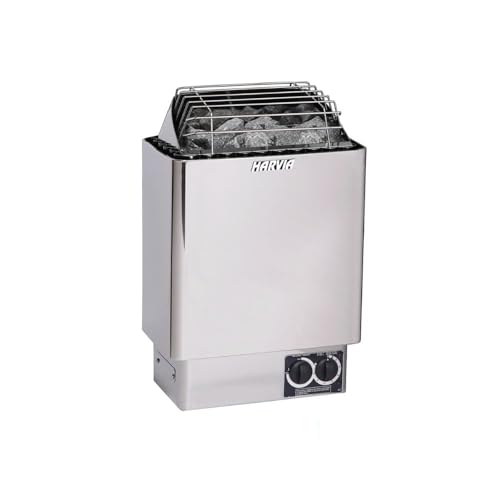
This 8kW unit is designed for larger home saunas ranging from 250 to 425 cubic feet, delivering fast and consistent heating. It features built-in controls for easy operation directly from the heater and a durable stainless steel housing. Best for users who want strong performance and a clean aesthetic with convenient, non-app-based controls. A potential limitation is that it doesn’t offer WiFi connectivity for remote control.
Mxmoonant 9KW Sauna Heater With External Digital Control

The Mxmoonant 9KW heater emphasizes even heat distribution and a compact footprint with a wall-mounted design to maximize center-room space. It uses an external digital control, allowing you to manage temperature and timings from a wall panel or remote interface. It’s best for mid-to-large rooms where space efficiency matters and you want solid performance without integrated WiFi. Potential caveat: the external control may require an additional setup step or compatibility check with your preferred smart ecosystem.
Buying Guide
What to consider when selecting a wifi-enabled sauna heater:
- Room size and heater capacity: Choose a model rated for your sauna’s cubic feet. Oversizing or undersizing affects heat distribution and energy use.
- Controls and connectivity: If you want smart features, verify that the heater supports WiFi, the control app, and compatibility with your home network.
- Installation and space: Wall-mounted units save floor space but require secure mounting and appropriate clearance around the unit.
- Stone cavity and heat distribution: A larger stone cavity generally yields more uniform heat and longer heat release after cycling.
- Durability and materials: Stainless steel housings resist corrosion in humid environments and extend service life.
- Maintenance: Some models offer built-in controls, others rely on external or app-based management—consider which setup suits your routine.
Practical buying questions
- Do I need WiFi control or is digital/manual control enough? For hands-free scheduling, WiFi control is advantageous, but digital controls offer reliable operation without network dependency.
- What space will the heater occupy? Measure the sauna dimensions and ensure the heater fits with required clearance around the unit.
- Is the heater compatible with my sauna stones? Most models include stones or specify stone compatibility; ensure the stone cavity matches your setup.
- What is the best heater for a small home sauna? Models around 4.5–6 kW are typically suitable for compact rooms, with digital controls as a simplifying factor.
- How important is heat distribution? Heaters with larger stone cavities and higher-quality heating elements tend to provide more even heat and longer warmth after cycles.
FAQ
- What is the main advantage of wifi-enabled sauna heaters? They allow remote control, scheduling, and monitoring from a mobile device for convenience.
- Can I mix wifi and non-wifi heaters in the same sauna? Yes, you can mix, but ensure the control mechanisms won’t conflict with timers or safety features.
- Do all wifi heaters require a dedicated app? Most do, but some also integrate with broader smart home ecosystems.
- Which heater is best for larger saunas? Heaters with higher kilowatt ratings (e.g., 8–10 kW) are generally better for larger spaces, provided electrical capacity supports it.
- Are stainless steel heaters more durable in humid environments? Yes, stainless steel housings resist corrosion and heat exposure better over time.
- What safety features should I look for? Overheat protection, timer controls, and proper clearances around the heater are essential.