For a fence that preserves an open view, the FXW metal garden fence is the clearest match in this selection because its wire panels allow an unobtrusive view. If you want airflow with more screening, consider a slatted wood panel or breathable mesh screen instead. The iCover and Shade&Beyond screens are 4 feet high, while UPGRADE is 6 feet high and designed for stronger visual coverage. Check your fence measurements and decide how much visibility you want before choosing.
| Product | Best for | Visibility approach |
|---|---|---|
| FXW No Dig Garden Fence | Open views and garden boundaries | Unobtrusive wire panels |
| 3 Panels No Dig Wood Screen | Hiding outdoor equipment | Slats allow airflow |
| iCover 4-by-50-foot Screen | Airy fence screening | Breathable knitted mesh |
| Shade&Beyond 4-by-50-foot Screen | High-coverage mesh | Blocks most visibility |
| UPGRADE 6-by-50-foot Screen | Taller, more private fences | Up to 90% blackout |
FXW No Dig Garden Fence
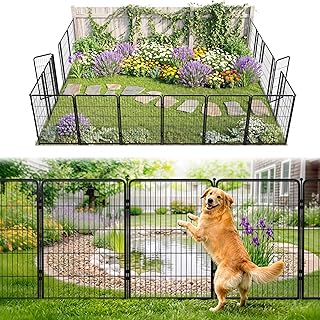
Best for: Buyers who want a defined yard or garden boundary without blocking the view. The product is listed as 40 inches high and 36.4 feet long across 16 panels. Its welded metal wire construction is described as allowing an unobtrusive view, making it the strongest match here for a see-through fence.
The panels connect by aligning their rings and threading a stake through them. They can be rearranged into different shapes, which is useful when a straight run is not the only layout needed. Rounded stake tips and rods designed for easier insertion are also listed features.
Limitation: This open wire design does not provide the substantial visual privacy offered by mesh screens or solid panels. Choose it for visibility and separation, not to hide a yard or equipment.
No-Dig Wood Privacy Screen Panels

Best for: Homeowners who want to conceal an air conditioner, trash cans, pool equipment, or other outdoor utilities while retaining some airflow. The three panels measure 42 inches high by 40 inches wide, and their natural wood grain gives each panel a distinct appearance.
The slatted construction is a middle ground between an open wire fence and a solid visual barrier: it offers screening while allowing air to pass through. Installation uses included metal ground stakes rather than digging or pouring concrete. This makes the product relevant to buyers seeking freestanding, small-area screening rather than a long fence-covering roll.
Limitation: The listed dimensions cover three individual panels, not a 40-foot fence. Natural wood also has color and grain variations, so the finished appearance may not be uniform.
iCover Breathable Fence Screen

Best for: Buyers who want a 4-foot-tall mesh covering that allows air and breeze through while reducing visibility. The screen measures 4 feet by 50 feet and is intended for fences around 4 feet high or slightly taller. Its knitted net is designed to provide screening without making the space feel as visually cramped as a solid barrier.
Reinforced bindings and brass grommets support attachment along the fence. The product description notes three grommets arranged in a triangular pattern to help distribute pulling force. Choose this screen if a breathable, long-run covering matters more than maintaining a clear view through the fence.
Limitation: It is a privacy screen, not a transparent panel. Measure the fence before ordering; the listed height may not suit taller fences without leaving an uncovered area.
Shade&Beyond 170 GSM Mesh Screen

Best for: Buyers who want a 4-by-50-foot screen with stated coverage of 90% of visibility while still allowing air and wind passage. It is made from UV-protected, non-recycled HDPE fabric, with reinforced double-layer edges and rust-resistant stainless-steel grommets listed in the features.
Compared with the open FXW wire panels, this mesh is better for screening sightlines while keeping some airflow. Its dimensions suit a long fence run, and the grommets on each side are intended to help secure installation. It may work for a yard, garden, or outdoor wall where a screened rather than open appearance is preferred.
Limitation: A screen that blocks 90% of visibility will substantially reduce the view through the fence. It is not the right choice when keeping the other side clearly visible is the main goal.
UPGRADE 6-Foot Fence Privacy Screen

Best for: Buyers who need a taller screen and prioritize privacy over a clear view. This 6-by-50-foot cover is made from 170 GSM non-recycled HDPE and is described as providing up to 90% blackout. Reinforced edges with double support and anti-rust brass grommets are listed to support outdoor installation.
Compared with the 4-foot screens in this selection, its 6-foot height may better suit taller fence runs. The material is also described as weather-resistant and as providing UV shielding. Choose it when the goal is substantial coverage across a long backyard fence.
Limitation: Its high stated blackout level makes it a poor fit for a see-through fence. Confirm both fence height and length before buying.
Buying Guide: How to Choose See-Through Fence Panels
Do you need an open view or visual privacy?
Start by deciding what should be visible through the fence. Open wire panels, such as the FXW option, suit boundaries where sightlines matter. Slatted wood offers a compromise: it screens equipment while allowing airflow. Knitted mesh is better for reducing visibility, but it also limits the view.
How should you compare panel and screen dimensions?
Measure the fence height and the full length that needs coverage. Compare those measurements with the product’s stated size, and account for corners or gaps in the layout. A set of three panels serves a smaller area than a 50-foot roll. Do not assume a screen will fit a taller fence without checking its listed height.
What installation details should you check?
Look at the attachment method before choosing. The mesh screens list grommets and reinforced edges for securing the fabric. The wood panels use ground stakes, while the FXW panels connect with rings and stakes. Match the product’s installation approach to your fence or yard setup.
How do airflow and coverage compare?
Wire panels provide the most open view in this group. Slats and knitted mesh permit airflow, but the mesh products are specifically intended to block sightlines. Higher coverage can be helpful for privacy, yet it is a trade-off if you want to see through the fence.
Frequently Asked Questions
Which option is most see-through?
The FXW metal wire fence is the clearest match because its product features describe an unobtrusive view through the panels.
Do fence privacy screens allow airflow?
The iCover and Shade&Beyond mesh screens are described as breathable and as allowing air or wind to pass through. They reduce visibility, so airflow does not mean they are see-through.
Which product is designed to hide outdoor equipment?
The three-panel wood screen is specifically described for concealing items such as air conditioners, trash cans, and pool equipment while allowing airflow through its slatted design.
What should I measure before ordering?
Measure the height and length of the area to cover, then compare those figures with the product dimensions. Also account for corners, panel spacing, and any sections that should remain open.
Are mesh screens the same as see-through fence panels?
No. Mesh screens are designed to reduce visibility while allowing some air through. Choose an open wire panel if seeing through the fence is more important than privacy.