Answering the typical buyer question, these shallow-well pressure tanks help maintain steady water pressure when the pump isn’t running. They’re best for homeowners with private wells, gardens, and small to mid-size irrigation needs. This guide highlights five solid options, explains who each is best for, and points out practical limitations to consider before buying.
| Product | Best For | Tank Size | Notes |
|---|---|---|---|
| Red Lion 6AH, Horizontal Pre-Charged Well Pressure Tank | Small homes or cottages needing compact, durable tanks | 6 gallon | Pre-charged to 20 PSI; 20-gauge steel with leak-safe connection |
| Reliance Pressure Tank – Pre-Charged, 20 Gal | Mid-size homes with higher daily water use | 20 gallon | Large capacity to reduce refills; robust outdoor design |
| Red Lion RL20A, Vertical Pre-Charged Well Pressure Tank | Mid-to-large families needing reliable supply | 20 gallon | Typical well setup; durable steel construction |
| VEVOR 34-Gallon Vertical Well Pressure Tank | Whole-house systems with substantial daily usage | 34 gallon | Not for drinking water; high capacity and robustness |
| Red Lion RL4A, In-line Pre-Charged Well Pressure Tank | Compact, inline replacement in existing lines | 4 gallon | Small footprint; pre-charged for easy setup |
Red Lion 6AH Horizontal Pre-Charged Tank

Best for compact spaces and easier installation, this 6-gallon horizontal tank is designed to work with a well pump system to maintain water pressure when the pump is not running. It is NSF/ANSI/CAN 61 and 372 certified for safe drinking water, and uses a heavy-duty 20-gauge steel body with a leak-safe connection. The diaphragm is made of butyl rubber to support reliable pressure. Set-up requires topping off the air side to two psi below the switch cut-in after initial charging.
Who it’s best for: small homes or cottages with limited space and a lower daily water demand. Caution: ensure proper pre-charge adjustments; under- or over-pressurizing can affect pump cycling and water flow.
Reliance Pressure Tank – 20 Gal

This large-capacity tank is designed to support extended lawn and garden spraying tasks and other outdoor water needs. It’s a pre-charged, free-standing unit built to withstand outdoor conditions, making it a strong choice for properties with significant irrigation demands. It integrates with standard pressure tank systems to deliver consistent flow.
Who it’s best for: households with substantial outdoor water use or larger irrigation plans. Caution: not intended for use where drinking water is sourced directly from the tank; verify compatibility with your existing pump setup.
Red Lion RL20A Vertical Pre-Charged Tank

Vertical, pre-charged, and built to sustain a well pump system, this 20-gallon tank shares the same robust build as other Red Lion models: a heavy-duty steel body, stainless water connection, and a reliable diaphragm. Pre-charge is 20 PSI, requiring an air adjustment to two PSI below the cut-in setting for optimal performance.
Who it’s best for: homeowners who want a durable, standard-capacity tank with straightforward installation. Caution: ensure proper leveling and support for vertical tanks in areas with vibration or shifting soil.
VEVOR 34-Gallon Vertical Well Tank
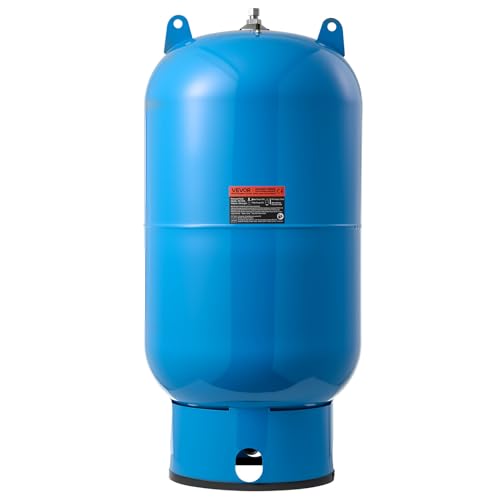
Designed for whole-house water supply needs, the VEVOR 34-gallon vertical tank offers substantial storage and stable pressure. It’s constructed from durable carbon steel, with a 1-inch NPT connector for secure pipe fitting. The pre-charge is 36.2 PSI, and the unit can withstand higher internal pressures with a comfortable operating ceiling around 116 PSI.
Who it’s best for: larger homes or properties with higher continuous water demands. Caution: not suitable for drinking water applications; verify local code compliance and pump compatibility before installation.
Red Lion RL4A In-line 4-Gallon Tank

Inline, compact, and pre-charged, the RL4A is useful for replacing a small section of an existing pipeline without major system overhauls. It’s built with the same high-quality materials as other Red Lion models and uses a pre-charge method to simplify setup. This option is best for tight spaces and small-scale pressure maintenance.
Who it’s best for: homes needing a quick inline upgrade or a small buffer in a constrained space. Caution: its 4-gallon capacity supports modest usage and may require more frequent cycling for high demand days.
Buying Guide
- Tank size vs. demand: Choose a tank that matches daily water usage. Larger homes or extensive irrigation benefit from 20–34 gallon tanks, while smaller setups can use 4–6 gallon models.
- Material and durability: Look for steel tanks with leak-safe connections and corrosion-resistant fittings. Stainless steel connections and robust diaphragms extend lifespan in outdoor environments.
- Pre-charge and setup: Most tanks arrive pre-charged. The air pressure should be adjusted to two psi below the pressure switch cut-in setting for reliable cycling.
- Not for drinking water: Many tanks are not suitable for potable water streams. Confirm NSF/ANSI/CAN certifications where drinking water is a concern.
- Shallow-well compatibility: Ensure the tank’s size and connection type fit your well pump and piping. Inline models offer flexible installation in tight spaces.
- Installation considerations: Outdoor tanks require weatherproofing and stable mounting. Verify that your system’s pump, switch, and gauge are compatible with the tank’s specifications.
Frequently Asked Questions
- What is a shallow well pressure tank? It is a pressurized vessel used with a well pump to maintain consistent water pressure and reduce pump cycling.
- Do these tanks store potable water? Some models are certified for safe drinking water; others are not designed for drinking water storage. Check NSF/ANSI/CAN certifications if needed.
- How do I set the air charge? After initial charging, use a tire or bicycle pump to bring the air pressure to two psi below the pressure switch cut-in setting.
- Can I install any tank with any pump? Not always. Verify compatibility with your pump’s flow rate, switch settings, and piping fittings to avoid mismatched performance.
- Which tank is best for a large household? A higher-capacity vertical tank (like 20–34 gallons) generally provides more stable pressure and fewer cycles for higher daily water use.
- Do these tanks reduce water hammer? Yes, many models help reduce water hammer by providing a stable reservoir and smoother flow, depending on system configuration.