The best trailer mover depends on the trailer’s tongue weight, the surface, and whether you want manual or powered movement. For lighter trailers, the MAXXHAUL or JY PERFORMANCE dolly offers a manual option; the VEVOR 1500-pound model adds a vehicle-pulling mode. For powered positioning, consider the VEVOR electric dollies, matching their stated towing and load capacities to your trailer. “Single wide” does not establish compatibility by itself: check the trailer’s actual tongue weight, coupler, and the mover’s specifications before choosing.
| Product | Best suited for | Key listed capacity |
|---|---|---|
| MAXXHAUL Trailer Dolly | Manual movement across varied surfaces | 600 lb tongue weight |
| VEVOR 3600 lb Electric Dolly | Powered movement and maneuvering | 600 lb tongue load |
| VEVOR 5500 lb Electric Dolly | Powered, low-speed positioning | 5500 lb towing capacity |
| JY PERFORMANCE Trailer Dolly | Manual use with no tire inflation | 600 lb capacity |
| VEVOR 1500 lb Trailer Dolly | Manual or vehicle-pulling options | 1500 lb tongue weight |
MAXXHAUL 600-Pound Trailer Dolly

This manual dolly is best for owners repositioning a compatible, lighter trailer without relying on a tow vehicle. Its listed tongue-weight capacity is 600 pounds, and it is designed for boat, utility, and jet ski trailers.
The 12-inch pneumatic tires are specified for gravel, grass, concrete, and asphalt. The alloy-steel construction is intended for repeated use in garages, marinas, and outdoor storage. Those features make it a practical choice when the route includes more than smooth pavement.
Choose this if you want a manual mover with air-filled tires for varied surfaces. Limitation: its 600-pound tongue-weight rating rules it out when the trailer exceeds that stated limit; pneumatic tires also require inflation.
VEVOR 3600-Pound Electric Trailer Dolly

This powered dolly is best for buyers who want motor-assisted movement and a design intended to maneuver through turns. It has an 800W brushless motor, a Q235A steel frame, and a stated towing capacity of 3,600 pounds, with a separate 600-pound tongue-load capacity.
Its anti-tip design uses a removable swivel rear wheel. The 12.4-by-4.7-inch pneumatic tires have 4 mm-deep treads, while 8-inch solid swivel casters support turning. The listed surface types include cement, grass, and compact dirt roads.
Choose this if the powered operation, turning support, and listed surface features match your setup. Limitation: the towing capacity and tongue-load limit are different specifications; check both against your trailer rather than treating 3,600 pounds as the tongue-load rating.
VEVOR 5500-Pound Electric Jockey Wheel

This electric mover is best for buyers seeking powered, low-speed positioning with forward-and-reverse controls. Its listed pulling capacity is 5,500 pounds. The product also specifies a 600-pound load capacity, a 380W copper motor, and a four-point steel bracket system intended to secure the unit to the trailer.
The control handle is described as supporting precise steering. Listed movement speeds are 7 meters per minute empty and 5.2 meters per minute loaded. Its adjustable clamp height ranges from 12.2 to 24.8 inches, according to the product name.
Choose this if the clamp-height range and separate capacity figures suit your trailer and you want a powered jockey-wheel style mover. Limitation: the specified loaded speed is slow, so it is intended for positioning rather than rapid movement.
JY PERFORMANCE 600-Pound Trailer Dolly
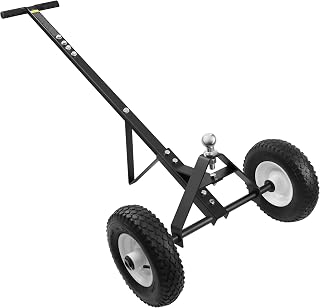
This manual dolly is best for lighter trailers and owners who prefer solid tires that do not need inflation. It has a listed 600-pound capacity, a 1-7/8-inch hitch ball, and 12-inch solid tires. Its black powder-coated steel construction is described as resistant to rust or wear.
A long handle and sturdy grip are intended to provide leverage and control while pushing or pulling. The product is positioned for moving small trailers or boats around a driveway or storage area.
Choose this if you want a straightforward manual option with solid tires. Limitation: its 600-pound capacity is lower than the VEVOR 1500-pound manual dolly’s stated tongue-weight capacity, and the listed hitch ball size should match your coupler requirements.
VEVOR 1500-Pound Two-Mode Trailer Dolly

This model is best for buyers who want a manual dolly that can also be switched to vehicle-pulling mode. Its stated tongue-weight capacity is 1,500 pounds, and it includes a 2-inch hitch ball for connecting with a trailer coupler.
The two pulling modes give it more flexibility than a manual-only dolly: the product describes hand-pulling the trailer or connecting the dolly for vehicle pulling. Its 16-inch pneumatic tires and universal wheel are listed features.
Choose this if you want the option of manual or vehicle-assisted movement and its capacity fits your trailer. Limitation: it is not described as an electric mover, and pneumatic tires are not solid, maintenance-free tires.
Buying Guide: How to Choose a Trailer Mover
What capacity should I check?
Start with the trailer’s tongue weight, then compare it with the mover’s stated load or tongue-weight limit. Do not confuse tongue weight with total trailer weight or towing capacity. Product descriptions may report these as separate figures, as the VEVOR electric models do. If you cannot confirm the relevant trailer measurement, get it before selecting a mover.
Should I choose manual or electric?
A manual dolly is a simpler choice for occasional repositioning when the trailer’s load and route are manageable by hand. Electric models provide powered movement and controls, but their capacities and operating details differ. Compare the exact specifications rather than assuming all electric movers suit the same trailer.
Which tire type works for my surface?
Pneumatic tires are featured on the MAXXHAUL and some VEVOR models, with product descriptions identifying surfaces such as grass, gravel, cement, or compact dirt. Solid tires avoid inflation, as on the JY PERFORMANCE model. Surface claims are product-specific, so check the description for the ground where you plan to move the trailer.
What coupler and clearance details matter?
Confirm the hitch-ball size, coupler fit, attachment method, and any required clamp-height range. The JY PERFORMANCE listing specifies a 1-7/8-inch ball, while the VEVOR two-mode dolly specifies a 2-inch ball. Do not assume that a mover fits because the trailer is described as a single wide.
Frequently Asked Questions
Can a trailer dolly move any single-wide trailer?
No. “Single wide” alone does not give the trailer’s tongue weight, coupler size, or ground conditions. Match those details to the mover’s listed specifications.
Is towing capacity the same as tongue-weight capacity?
No. Towing capacity describes a different load measure from tongue weight. Use the specification that corresponds to the trailer measurement and mover rating.
Are pneumatic tires better than solid tires?
Neither is universally better. Pneumatic tires are featured for varied surfaces on some models, while solid tires do not require inflation. Choose based on terrain and maintenance preference.
Can a manual dolly move a trailer without a vehicle?
Manual models are designed to be pushed or pulled by hand. The VEVOR two-mode dolly also lists a vehicle-pulling mode; check its instructions and your setup before use.