If you’re preparing for outdoor adventures, emergencies, or travel where clean water is not guaranteed, a reliable water filtration system is essential. This guide highlights five top options that suit different survival scenarios, from lightweight personal filters to portable purification tablets. The best choice depends on how you source water, how much you need to drink, and how long you’ll be away from reliable supplies. Below, you’ll find quick buyer insights, followed by in-depth product details and a practical buying guide with key considerations.
| Product | Best For | |
|---|---|---|
| LifeStraw Personal Water Filter | Solo hikers and emergency kits | Compact, lab-verified filtration |
| Waterdrop Gravity Filter Straw | Groups and longer trips | Gravity-fed for multiple liters |
| Membrane Solutions S1 Filter Straw (4 Pack) | Backup options and multi-user scenarios | NSF-certified, 1,320+ gallons lifetime |
| Aquatabs Purification Tablets | Emergency kits and travel light | Chemical purification with fast results |
| Potable Aqua Purification Tablets | Versatile emergency water treatment | Two bottles included for extended use |
LifeStraw Personal Water Filter For Hiking

Best for solo travelers who need a lightweight, field-proven filter. The LifeStraw uses a microfiltration membrane to remove 99.999999% of waterborne bacteria and 99.999% of parasites, including E. coli, Giardia, and Cryptosporidium. It also reduces turbidity to improve taste. This device is ideal for day hikes, camping trips, and emergency kits where quick, reliable access to safe water matters. A key limitation is that it does not remove viruses; choose this if your water source is primarily bacteria and parasite concerns and you want a compact, ready-to-use option.
Why chosen: It’s a compact, field-tested option with strong laboratory verification, making it a strong first pick for individual adventurers and bug-out kits. The filter’s 1-micron membrane targets common pathogens in most natural sources, and its small size makes it easy to carry daily.
Best-for summary:
- Best for: Solo hikers, travelers, and emergency kits
- Pros: Lightweight, lab-verified claims, reduces microplastics
- Cons: Doesn’t remove viruses
Waterdrop Gravity Water Filter Straw
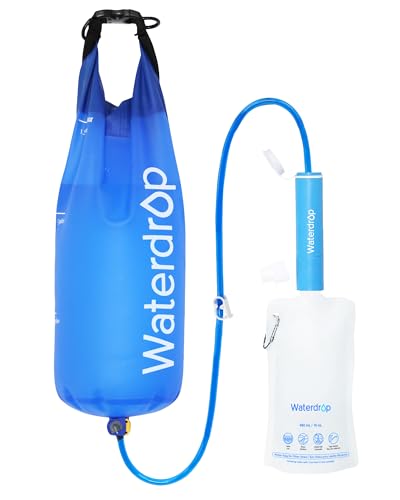
Best for groups and longer trips where you need higher overall water output without constant pumping. This system combines a gravity-fed filtration straw with a 1.5-gallon gravity bag, enabling up to 1,400 gallons of safe drinking water over its lifetime and a flow rate of up to 700 ml per minute. It removes chlorine, particulates, sediment, microplastics, and other contaminants with a 0.1-micron filtration standard. Consider this setup if you frequently rely on natural water sources and want a simple, low-effort purification process.
Who it’s best for: Outdoor parties, families, or anyone who wants to fill multiple bottles without laborious pumping. A potential limitation is the need to transport and assemble the gravity bag and filter together, which is more bulky than a single-straw option.
Membrane Solutions Personal Water Filter Straw S1 (Blue, 4 Pack)
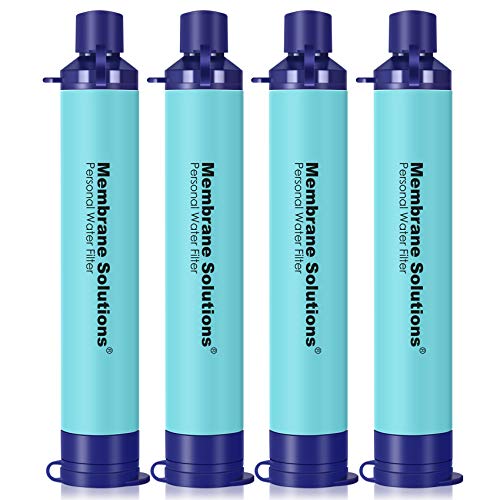
This 4-pack of personal filter straws provides a robust backup for multi-person kits or preparedness overlays. The straw is NSF/ANSI 42, 372, and 401 certified, meaning it’s tested for taste improvement, lead-free materials, and reduction of microplastics and particulates. It instantly removes 99.9999% of total coliforms, including E. coli, delivering reliable water on the go. Best for: groups needing multiple lightweight filters and for travelers who want extra safety redundancy. Limitation: the lifespan per unit is finite; plan for replacement parts in extended deployments.
Why selected: Triple NSF certification adds credibility and supports safe consumption across varying water sources. The compact 7.1-inch length suits pocket or pack carry, with a long lifespan per unit when combined with proper care and use.
Potable Aqua Water Purification Tablets

Best for compact emergency kits and international travel where liquid purification options aren’t practical. Each package includes two 50-tablet bottles, offering a portable, shelf-stable method to render water bacteriologically safe for drinking. Tablets are designed to purify water in a range of challenging settings, supporting safe hydration during camping, hiking, disasters, or transit. A limitation is the need for accurate wait times and proper dosage to achieve the desired purification level.
Who it’s for: Anyone wanting a lightweight, chemical-only solution as a backup to filtration systems. Choose this if you prefer a quick, non-mechanical method to treat water when fresh sources are scarce or inaccessible.
Practical Survival Reusable Emergency Water Filter Straws, 2-Pack

Best for a two-person kit or as a spare option in larger survival setups. Each straw filter removes over 99.99% of bacteria and parasites, including microplastics down to 0.1 micron, in a compact, portable unit that weighs about 2 ounces. The two-pack increases readiness for couples or small groups. Limitation: with 2-pack, you’re relying on a shared filter lifespan; rotation and maintenance are essential to maximize usefulness.
Why this is a good addition: It provides an additional low-profile filtration option with similar capabilities to other straw filters, ensuring you have multiple reliable access points to clean water while on the move.
Buying Guide: Practical Considerations For Water Filtration Survival
What’s your water source and risk level?
Source variability drives the choice between mechanical filtration and chemical tablets. If you expect to encounter bacteria and parasites, a mechanical filter or a combination approach is wise. For high-traffic urban areas or uncertain travel, tablets act as a compact backup.
How many people need water?
Single-person kits favor compact filters like LifeStraw or compact straws. Groups benefit from gravity systems or multiple filters to maintain supply without constant pumping or refilling.
Do you need fast access or long-term durability?
Filters with higher flow rates are preferable when drinking needs are urgent, such as during hiking or after heavy physical activity. For longer expeditions, consider filters with high lifetime capacity and easy replacement parts.
What about microplastics and metals?
Look for certifications or claims about microplastics reduction and lead-free materials if these are concerns in your water sources. NSF/ANSI certifications provide independent verification for safety and performance.
Maintenance and portability
Weight, size, and ease of cleaning affect daily use. Gravity systems are heavier but convenient for multi-user groups, while individual straws maximize portability. Always plan for spare filters or purification tablets in extended trips.
Frequently Asked Questions
- Q: Do water filter straws remove viruses?
A: Most standard personal straw filters target bacteria and parasites; viruses are typically addressed by chemical tablets or higher-grade filtration systems. Check product specs for specifics. - Q: How long do purification tablets last in a kit?
A: Tablet shelf life varies by brand; store in a cool, dry place and rotate stock to ensure potency for emergencies and travel. - Q: Can I use a gravity filter with any bag?
A: Many gravity kits are designed to work with standard bags or compatible containers. Review compatibility notes for your model to ensure proper connections. - Q: Are NSF certifications necessary?
A: Certifications provide independent verification of claims. They help buyers compare products with confidence, especially for critical survival gear. - Q: Which option is best for a bug-out bag?
A: A compact personal filter for on-the-go filtration plus purification tablets for backup offers flexibility in uncertain environments. - Q: How should I maintain these filters?
A: Rinse or replace filters as recommended, keep spare parts, and store in a dry environment to extend lifespan and performance.