A heat-powered wood stove fan circulates warm air without batteries or a power cord, making it useful when you want to move heat around a room or heat off-grid. The VODA is best for buyers seeking an eight-blade design and a thermometer; Tomersun is better for buyers who want a mounting bracket and stated temperature guidance. JossaColar is a straightforward option with a magnetic thermometer, while the six-blade models suit buyers prioritizing quiet operation or oscillation.
| Product | Best for | Standout feature |
|---|---|---|
| JossaColar Heat-Powered Fan | Simple stove-top use | Aluminum blades and magnetic thermometer |
| Six-Blade Thermoelectric Fan With Bracket | Quiet or off-grid use | Stated 25 dB operation |
| VODA Eight-Blade Fan | Broader warm-air distribution | Eight blades and thermometer |
| Tomersun Eight-Blade Fan | Buyers who want a bracket | Bracket and temperature guidance |
| Oscillating Six-Blade Fan | Side-to-side airflow | 60-degree rotation |
JossaColar Heat-Powered Stove Fan

Best for buyers who want a simple heat-powered fan with a thermometer included. JossaColar says the fan uses heat rather than batteries, and its curved aluminum blades are designed to distribute warmth around the room. The product listing gives dimensions of 6.5 inches long and 7.7 inches high and describes use with wood stoves, log burners, and fireplaces.
The included magnetic thermometer provides a separate way to monitor stove temperature. This model is a practical choice if you want a compact fan and an accessory in one package. The listing also states that the product comes with a one-year replacement policy for quality problems.
Limitation: The listed features do not provide a specific airflow rate or operating temperature range, so buyers who need those details should check with the seller before choosing.
Six-Blade Fan With Heater Bracket

Best for buyers who value quiet operation or need a fan for a portable heater in an off-grid setting. This six-blade model converts heater heat into motion through a thermoelectric process, so it does not need electricity or batteries. The listing describes use for camping, cabins, garages, and other indoor or outdoor settings.
The product is listed with a bracket for fixing it to a propane heater, which can be useful when a stove-top placement is not the intended setup. Its stated operating noise is 25 dB, making quiet use a key point of comparison. Choose this model if those heater-mounting and noise details match your needs.
Limitation: The listing emphasizes portable and propane heaters. Confirm that the bracket and fan are appropriate for your specific heater before use rather than assuming a fit.
VODA Eight-Blade Heat-Powered Fan

Best for buyers who want an eight-blade fan and a magnetic thermometer in the package. VODA says the blade design moves warm air horizontally and is intended to help distribute heat more evenly around a room. The listing identifies wood-burning stoves and pellet stoves among possible uses.
The included thermometer can help monitor the stove or heater surface. VODA instructs users to remove the fan if the temperature exceeds 345°C, or 653°F. That threshold is an important part of this model’s operating guidance, so check the surface temperature rather than placing the fan without monitoring it.
Limitation: The provided features do not give a specific airflow measurement. Buyers comparing circulation by a numeric output may need more information from the manufacturer.
Tomersun Eight-Blade Fan With Bracket

Best for buyers who want an eight-blade fan with a bracket and stated temperature guidance. Tomersun describes the fan as suitable for most flat-top wood stoves and fireplaces, and says the included bracket is intended to secure it to a stove. The listing claims its eight-blade design moves 40% more warm air than standard four-blade models; treat that as the manufacturer’s comparison, not an independently verified measurement.
A magnetic thermometer is included. Tomersun lists an ideal operating range of 390°F to 480°F and advises avoiding temperatures above 570°F. It also describes bottom spring plates that bend and lift the fan to help prevent overheating.
Limitation: The stated temperature range is specific to this product. Follow its own guidance and verify your stove’s surface temperature before use.
Oscillating Six-Blade Stove Fan
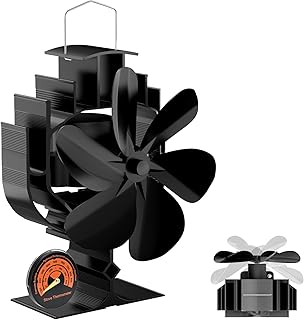
Best for buyers who want airflow to move from side to side instead of staying in one direction. This heat-powered fan has six blades and a listed 60-degree left-to-right rotation. Its horizontal airflow design is intended to help spread warmth across more of the room.
The listing also identifies a magnetic thermometer as an included accessory. Choose this model if oscillation is a priority and you want a non-electric fan for a wood-burning stove or fireplace.
Limitation: The provided features do not state the fan’s operating temperature range, dimensions, or a specific airflow rate. Check product details before buying if those measurements are important to your setup.
Buying Guide: How to Choose a Non-Electric Wood Stove Fan
How does a heat-powered fan work?
These fans use heat from a stove or heater to generate motion, rather than drawing power from an outlet or batteries. They are designed to circulate warm air, not to create heat. Their usefulness depends on having an appropriate heated surface and following the product’s placement and temperature instructions.
Should you choose six blades or eight?
Blade count alone does not establish how much air a fan moves. The VODA and Tomersun models list eight blades, while the other options list six. Compare the stated airflow direction, mounting needs, and any manufacturer-provided performance details instead of assuming that a higher blade count guarantees better results.
Do you need a bracket or oscillation?
A bracket may matter if you plan to mount a fan on a portable heater; confirm that it suits the specific appliance. For a stove-top setup, check the product’s stated placement guidance. An oscillating model may be preferable if you want airflow to sweep side to side rather than point in one direction.
What safety details should you check?
Review each model’s temperature limits and use a thermometer when one is included. The VODA and Tomersun listings provide different temperature guidance, so do not transfer one model’s limits to another. Confirm that the fan is intended for your type of stove or heater, and follow its instructions for positioning and removal.
Is a stove fan right for every room?
A stove fan can help move warm air away from the immediate stove area, but the listings do not promise a particular room temperature or heating outcome. Consider the room layout and where airflow should go. A fan without a stated airflow measurement may be harder to compare on circulation alone.
Frequently Asked Questions
Do wood stove fans need electricity?
The models in this guide are listed as heat-powered or thermoelectric and do not require batteries or a power cord to operate.
Can a heat-powered fan make a stove hotter?
No. These fans circulate warm air generated by the stove or heater; they do not create additional heat.
Can I use a wood stove fan on a propane heater?
Some listings describe heater use, including a model with a bracket for a propane heater. Confirm the specific product’s instructions and mounting suitability before use.
Why does a stove fan include a thermometer?
A thermometer can help monitor the temperature of the stove or heater surface. Follow the fan’s own temperature guidance to avoid exceeding its stated limits.
Which fan is best for side-to-side airflow?
The oscillating six-blade model is the listed choice for side-to-side movement, with a stated 60-degree rotation.